
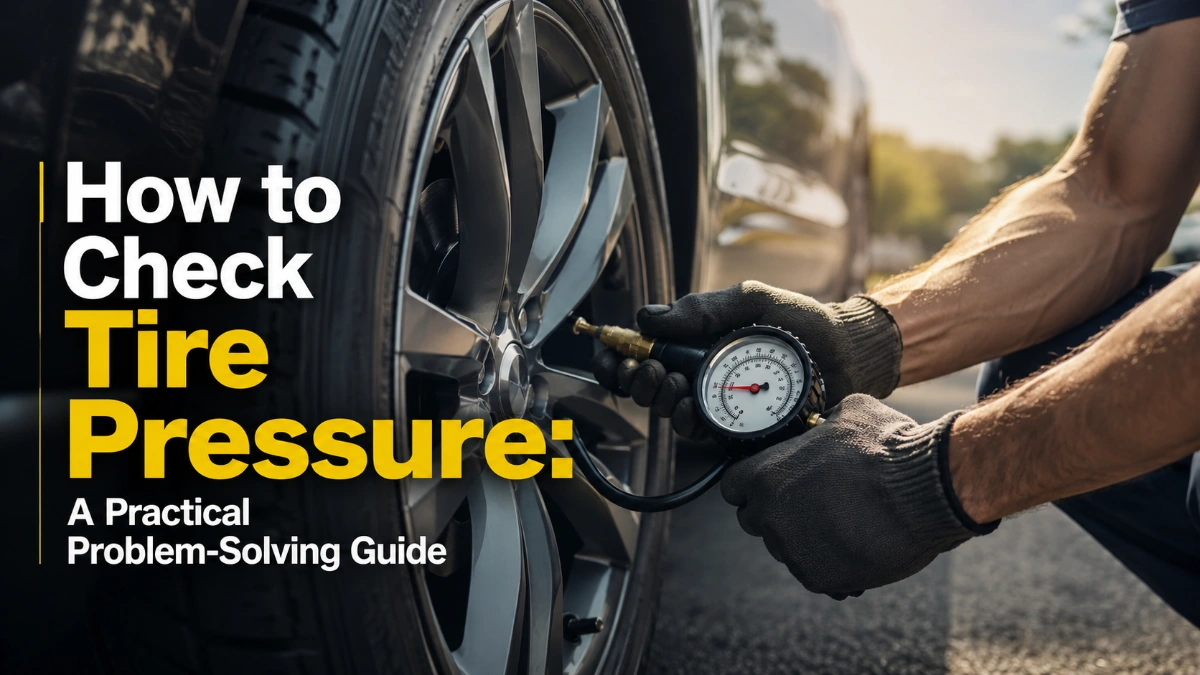
Most drivers don’t fail at checking tire pressure because the task is hard. They fail because of three specific, avoidable mistakes: using the wrong target number, checking at the wrong time, or misreading the gauge. Solving those three problems and learning how to check tire pressure stops being a mystery and becomes a five-minute routine.
Problem: You Don’t Know What Number to Aim For
The mistake: Many drivers check the number printed on the tire’s sidewall and assume that’s the target.
Why it’s a problem: The sidewall figure is the tire’s maximum safe pressure, not the pressure your vehicle’s manufacturer actually wants for daily driving. Using it as your target routinely leads to overinflation.
The solution: Find the sticker inside your driver’s side door jamb, or open your owner’s manual. Manufacturers set this recommended PSI based on your car’s weight, suspension, and handling, and it’s usually lower than the sidewall number. Front and rear tires often carry different recommended figures, so read the full placard rather than one number.
Action step: Before you touch a gauge, locate and note down your car’s actual recommended PSI for front and rear tires.
Problem: You’re Checking at the Wrong Time
The mistake: Checking pressure right after a drive, when the tires are still warm.
Why it’s a problem: Heat expands the air inside a tire, which pushes the reading up by several PSI above the true resting pressure. A warm-tire reading can trick you into releasing air that the tire actually needs.
The solution: Tire manufacturers generally recommend checking when tires are “cold,” meaning the car has been parked at least three hours or driven less than a mile. This single timing fix is one of the biggest factors in getting an accurate result when learning how to check tire pressure.
Action step: Plan your check for first thing in the morning, before the car has moved, rather than right after a drive.
Problem: You Don’t Have the Right Tool, or You’re Using It Wrong
The mistake: No gauge on hand, or pressing it onto the valve stem at an angle.
Why it’s a problem: Without a gauge, you’re guessing. With a misaligned gauge, air leaks out during the reading and gives you a falsely low number.
The solution: Any of the three common gauge types works, provided you use it correctly.
| Gauge Type | Best For |
| Pencil-type | Budget-friendly, compact glovebox option |
| Dial gauge | Quick visual read via an analog face |
| Digital gauge | Most precise, easiest for beginners to interpret |
Action step: Press the gauge straight onto the valve stem until the hissing stops, then read the number immediately.
Problem: The Actual Checking Process Feels Unclear
The mistake: Skipping steps or checking tires in a random order without a system.
The solution: Follow the same six-step sequence every time you check tire pressure, so the process becomes automatic.
- Remove the valve stem cap by twisting it counterclockwise.
- Press the gauge straight onto the stem until hissing stops.
- Read the number shown on the rod, dial, or digital display.
- Compare it to your noted recommended PSI.
- Replace the valve stem cap.
- Move to the next tire, ending with the spare.
Action step: Keep a written or saved note of your recommended PSI in the car so you never have to search for it mid-check.
Problem: The Reading Is Off, and You Don’t Know What to Do Next
The mistake: Leaving a tire underinflated or overinflated because the correction step feels intimidating.
The solution: Correcting pressure is simpler than it sounds.
If pressure is too low: Attach an air compressor nozzle to the valve stem and add air in short bursts, checking with your gauge between each burst.
If pressure is too high: Use the gauge’s built-in release valve, or press the small pin inside the valve stem with a flathead screwdriver, releasing air gradually while rechecking often.
Action step: Never add or release air in one long burst; always check between small adjustments.
Problem: You Check Once and Forget About It
The mistake: Treating tire pressure as a one-time task rather than an ongoing habit.
Why it’s a problem: Pressure naturally drifts from slow air loss and temperature swings, so a single check goes stale within weeks.
The solution: Build a simple recurring schedule: a monthly check, an extra check before long trips, and a check whenever the season shifts, since cold weather lowers pressure and warm weather raises it.
Action step: Set a recurring monthly reminder, and include the spare tire on that same schedule since it’s easy to forget and often needs a different PSI than your other four tires.
Problem: You’re Relying on the TPMS Light Instead of Checking Manually
The mistake: Assuming that if the TPMS warning light hasn’t turned on, the pressure must be fine.
Why it’s a problem: TPMS typically only triggers a warning once pressure drops past a set threshold, so a tire can run moderately low without any alert appearing.
The solution: Treat the TPMS light as a backup, not a replacement for manual checks. Knowing how to check tire pressure by hand catches small losses well before the dashboard would ever flag them.
Action step: Do a manual check monthly, regardless of whether the TPMS light is on.
Frequently Asked Questions
Using the sidewall’s maximum PSI instead of the manufacturer’s recommended number from the door jamb sticker.
Driving heats the air inside the tire, temporarily raising the reading; checking when tires are cold gives the most accurate number.
A digital gauge is usually the easiest to read correctly since it shows an exact number rather than requiring dial or rod interpretation.
Use the gauge’s release valve or press the valve stem pin with a small tool, releasing air in short intervals while rechecking.
Yes, many vehicles have different recommended PSI values for front and rear axles, listed on the same door jamb placard.
It needs checking on the same schedule, but often at a different, sometimes higher, PSI than your regular tires.
Only partially. It typically alerts after pressure passes a defined threshold, so moderate drops can go unnoticed without a manual check.