
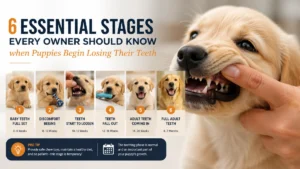
Most puppies start losing baby teeth at about 12–14 weeks old. Their adult teeth continue to emerge over the following months, and most dogs have their complete adult set by roughly 6–7 months of age.
A missing tiny tooth, more chewing, or slight gum tenderness can be normal during this stage. The key concern is a baby tooth that remains beside an adult tooth, particularly a canine tooth, because this can crowd the permanent tooth or affect the bite.
When do puppies start losing their teeth? Usually at around three months old. The small front teeth, called incisors, often loosen first, followed by the canines and premolars.
Teething is a process, not a one-day event. Baby teeth begin shedding as permanent teeth develop and move into position, so a puppy’s mouth can look different from week to week.
Puppy teething timeline
| Puppy age | What usually happens |
| 3–5 weeks | Baby teeth begin to erupt |
| Around 8 weeks | Most puppies have all 28 baby teeth |
| 12–14 weeks | Baby teeth commonly begin to fall out, often starting with incisors |
| 4–5 months | Adult teeth are appearing more widely, including replacement teeth |
| 4–6 months | Canines and premolars are replaced; adult molars erupt at the back |
| 6–7 months | Most dogs have their full set of 42 adult teeth |
When do puppies start losing their teeth can vary slightly by puppy and by tooth type. A puppy may lose front teeth while still having baby canines or premolars, so one missing tooth does not mean the whole process is nearly complete.
Adult molars are different: puppies do not have baby molars. Those permanent molars simply emerge behind the premolars as the jaw grows.
What normal teething looks like
When do puppies start losing their teeth, owners often notice increased chewing before they see a lost tooth. Puppies explore with their mouths, and sensitive gums can make a suitable chew toy especially appealing.
Normal signs may include:
- More chewing or mouthing than usual
- A tiny tooth is missing from the front of the mouth
- Mild temporary gum redness
- A small spot of blood on a toy
- A shed tooth found on the floor, or no tooth found at all
- A short period where a baby tooth and an adult tooth appear side by side
Many owners never find a shed baby tooth because puppies can swallow it while eating or playing. If your puppy is comfortable, eating normally, and has no continuing bleeding or breathing difficulty, that alone is usually not an emergency.
How to help safely
When do puppies start losing their teeth, chewing should be redirected rather than punished. Offer puppy-appropriate chew toys, supervise use, and replace a toy once it has cracks, sharp edges, or pieces that could be swallowed.
Avoid objects that are exceptionally hard, such as stones, hard bones, antlers, or rigid items that do not give under pressure. Hard objects may damage teeth, while broken fragments can create choking or digestive risks.
A safer teething routine includes:
- Offering a few size-appropriate chew toys and rotating them
- Redirecting hands, sleeves, and furniture biting onto a toy
- Supervising all new chews and removing damaged items
- Checking that the item cannot be swallowed whole
- Keeping play sessions calm if your puppy seems mouth-sensitive
Do not try to pull out a loose baby tooth. Let the tooth shed naturally, and ask a veterinarian for guidance if a tooth seems painful, broken, or slow to fall out.
Double teeth need attention
When do puppies start losing their teeth, a permanent tooth may sometimes emerge before the baby tooth has fallen out. This is called a retained deciduous tooth, also known as a persistent baby tooth.
The most obvious example is a double canine tooth: a smaller baby canine remains next to a larger permanent canine. Retained teeth can crowd or redirect the adult tooth, trap food between teeth, and contribute to bite or gum problems.
Small breeds and short-nosed breeds can be more prone to retained baby teeth, but any puppy with an adult tooth growing beside a baby tooth should be checked by a veterinarian. The veterinarian can determine whether monitoring or extraction is appropriate and whether dental imaging is needed.
When to call the vet
When do puppies start losing their teeth is a useful developmental guide, but it should not replace a veterinary examination when a puppy seems painful or the mouth looks abnormal.
Book a veterinary appointment if you notice:
- A baby tooth still present beside an erupting adult tooth
- Persistent, heavy, or repeated bleeding from the mouth
- Facial swelling, discharge, or an unusually bad mouth odour
- Refusal to eat, yelping while chewing, or repeated pawing at the mouth
- A tooth pressing into the gums, palate, or another tooth
- Difficulty closing the mouth or an obviously uneven bite
- A mouth that still looks crowded or incomplete near the end of the teething period
A routine puppy wellness appointment is also a good opportunity for a mouth check. Retained teeth are easier to address before they contribute to crowding or an abnormal bite.
Start dental habits early
When do puppies start losing their teeth? Gentle handling can help prepare them for future dental care. Start by briefly touching the muzzle and lifting the lips, then reward calm behavior. Build slowly rather than forcing the mouth open.
Once your puppy tolerates mouth handling, introduce a soft toothbrush or finger brush with toothpaste made for dogs. Human toothpaste should not be used because dogs swallow toothpaste instead of spitting it out, and human products can contain ingredients that upset the stomach or are unsafe for dogs.
Keep early sessions short and positive. The aim is not perfect brushing on day one; it is helping your puppy accept regular mouth handling and dental care without fear.
Frequently Asked Questions
Most puppies complete the transition to adult teeth by about 6–7 months old. Timing varies, so a veterinary check is sensible if the mouth still appears crowded or if adult teeth seem missing.
Yes. Puppies may swallow shed baby teeth while eating or playing, which is why owners often never find them. Seek prompt veterinary advice if swallowing is accompanied by choking, repeated vomiting, or obvious distress.
This often means the baby canine has not fallen out while the permanent canine is erupting. A veterinarian should assess this because retained baby teeth can alter the position of adult teeth and affect the bite.
No. Do not pull it at home. Let it shed naturally, and speak with a veterinarian if the tooth appears painful, broken, or remains in place beside a permanent tooth.
A little temporary gum bleeding can occur. Persistent, heavy, or recurring bleeding should be evaluated by a veterinarian.
No. Puppies do not have baby molars. Adult molars grow in behind the premolars as part of the permanent set.
Choose puppy-appropriate chew toys that match your dog’s size and chewing style. Supervise use, inspect toys regularly, and avoid objects that are extremely hard or break into pieces.
Yes, but start gradually. Begin with gentle mouth handling, then use a soft brush and dog toothpaste once your puppy is comfortable. Keep sessions brief and stop if your puppy appears distressed.
They can be more common in small-breed and short-nosed dogs. However, any puppy with a retained tooth should receive veterinary advice.
What if my puppy still has baby teeth at seven months?