
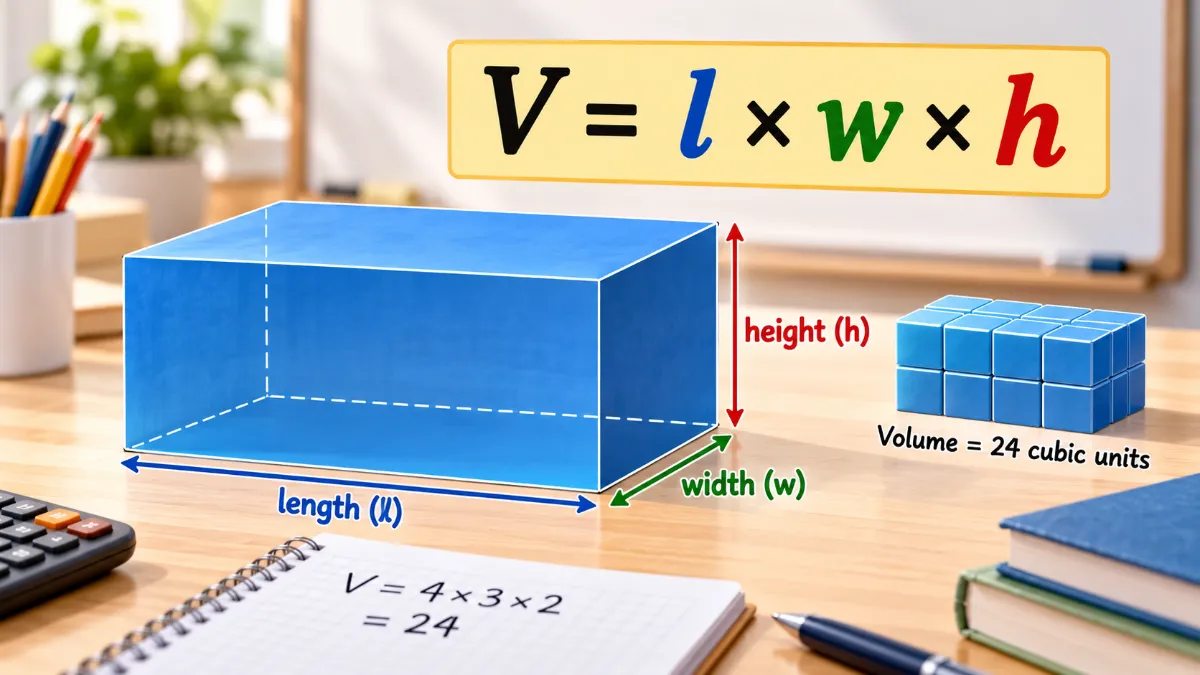
The volume of a rectangular prism is the amount of three-dimensional space it occupies. To calculate it, multiply its length, width, and height using the formula V = l × w × h, where V represents volume, l is length, w is width, and h is height. For example, a rectangular prism measuring 6 cm long, 4 cm wide, and 3 cm high has a volume of 6 × 4 × 3 = 72 cm³.
Volume is measured in cubic units, such as cubic inches (in³), cubic feet (ft³), or cubic centimeters (cm³). The formula works for rectangular boxes, storage containers, bricks, and other objects shaped like rectangular prisms.
How to Find the Volume of a Rectangular Prism
Finding volume involves three measurements and a simple multiplication. You can also explore rectangular prism volume examples to see how the formula works with different dimensions.
The formula is:
\[ \boxed{V=l\times w\times h} \]
Follow these steps:
- Measure the length: Find the distance along one edge of the rectangular base.
- Measure the width: Identify the perpendicular edge of the base.
- Measure the height: Find the perpendicular distance between the bottom and top faces.
- Check the units: Make sure all three measurements use the same unit.
- Multiply: Calculate length × width × height and write the result in cubic units.
Length and width describe two perpendicular directions along the base, while height extends perpendicular to that base. Together, these three measurements determine the prism’s volume.
For example, suppose a rectangular prism measures 8 inches long, 5 inches wide, and 4 inches high.
V=854
V=160in3
The prism occupies 160 cubic inches of space.
The order of multiplication does not affect the answer because multiplication is commutative.
Why Does the Volume Formula Work?
A rectangular prism has six rectangular faces. Its volume becomes easier to understand when you imagine filling it with small cubes, each measuring one unit along every edge.
Suppose a prism is 4 units long, 3 units wide, and 2 units high.
One horizontal layer contains:
43=12unitcubes
Since the prism is 2 units high, it contains two identical layers.
122=24
The total volume is 24 cubic units.
This explains another useful formula:
\[ \boxed{V=B\times h} \]
Here, B represents the area of the base, and h represents the height.
Because the base is rectangular:
B=lw
Therefore:
V=(lw)h
Both formulas produce the same result. Multiplying the base area by the height counts the cubic units throughout the solid. This relationship is also part of Grade 5 volume and measurement standards.
Volume of a Rectangular Prism Examples
The same method works with whole numbers, decimals, and measurements of everyday objects.
Example 1: Calculating Volume With Decimal Measurements
A rectangular prism measures 2.5 meters long, 1.2 meters wide, and 4 meters high.
Step 1: Write the formula.
V=lwh
Step 2: Substitute the measurements.
V=2.51.24
Step 3: Multiply.
V=34=12
Answer: 12 m³
Decimal dimensions do not change the formula. You just need to multiply carefully.
Example 2: Finding the Volume of a Storage Box
A rectangular storage box measures 12 inches long, 8 inches wide, and 5 inches high.
V=1285
V=480in3
The box has an external rectangular volume of 480 cubic inches.
If you want to know how much space is available inside a real box, use its internal dimensions instead.
Understanding Cubic Units
Volume uses cubic units because it measures space in three dimensions.
When length, width, and height are multiplied, their units are multiplied too.
For example:
3cm4cm5cm=60cm3
Common units include:
- Cubic inches (in³): Small objects measured in inches.
- Cubic feet (ft³): Larger storage spaces measured in feet.
- Cubic centimeters (cm³): Small objects measured in centimeters.
- Cubic meters (m³): Large spaces measured in meters.
These are all units of three-dimensional space. The SI units of volume also explain how cubic metric units relate to liters and milliliters.
Why Measurement Units Must Match
Suppose a prism has a length of 2 feet, a width of 12 inches, and a height of 6 inches.
First, convert 2 feet into 24 inches. Then multiply:
V=24126
V=1,728in3
Converting all dimensions to the same unit ensures the final answer is calculated and labeled correctly.
Rectangular Prism Volume Word Problems
Word problems help you practice identifying the necessary measurements and applying the formula in real situations.
Word Problem 1: Finding Container Volume
A rectangular container has internal measurements of 15 cm long, 10 cm wide, and 8 cm high. What is its internal volume?
Solution:
V=15108
V=1,200cm3
Answer: The container has an internal volume of 1,200 cm³.
Because 1,000 cm³ equals 1 liter, this corresponds to 1.2 liters of geometric capacity when filled.
Word Problem 2: Finding a Missing Dimension
A rectangular prism has a volume of 240 cm³, a width of 6 cm, and a height of 5 cm. What is its length?
Start with:
V=lwh
Rearrange the formula:
l=Vwh
Substitute the known values:
l=24065
l=24030=8cm
Answer: The missing length is 8 cm.
You can use the same approach when width or height is unknown:
w=Vlh
h=Vlw
To find a missing dimension, you need to know the total volume and the other two dimensions.
Common Mistakes When Calculating Volume
Even a simple formula can produce incorrect results if measurements or units are handled carelessly.
1. Confusing volume with surface area
Volume measures the three-dimensional space an object occupies. Surface area measures the combined area of its outside faces. Volume uses cubic units, while surface area uses square units.
2. Forgetting to multiply all three dimensions
Multiplying only length × width gives the area of the rectangular base, not the entire volume. You must also multiply by height.
3. Mixing measurement units
Convert measurements to the same unit before multiplying rather than mixing feet and inches.
4. Writing square units instead of cubic units
When three centimeter measurements are multiplied, the answer is expressed in cm³, not cm².
5. Using outside measurements for container capacity
A box’s usable internal volume depends on its inside dimensions, not its outside measurements.
Practice Questions and Answers
Try solving these problems on your own before checking the answers.
Question 1: A rectangular prism measures 7 cm long, 4 cm wide, and 3 cm high. Find its volume.
Answer:
\[ 7\times4\times3=\boxed{84\text{ cm}^3} \]
Question 2: A prism measures 2.5 m long, 2 m wide, and 1.5 m high. What is its volume?
Answer:
\[ 2.5\times2\times1.5=\boxed{7.5\text{ m}^3} \]
Question 3: A rectangular prism has a volume of 180 in³, a length of 9 inches, and a width of 4 inches. Find its height.
Answer:
\[ h=\frac{180}{9\times4} =\boxed{5\text{ in}} \]
Frequently Asked Questions
Does the order of length, width, and height matter?
No. Multiplying length × width × height gives the same result regardless of the order. What matters is using the three perpendicular dimensions and keeping their measurement units consistent.
Is volume the same as capacity?
Not exactly. Volume measures the space an object occupies or encloses, while capacity describes how much a container can hold. For a rectangular container, internal volume can be used to calculate its geometric capacity. One cubic centimeter equals one milliliter.