
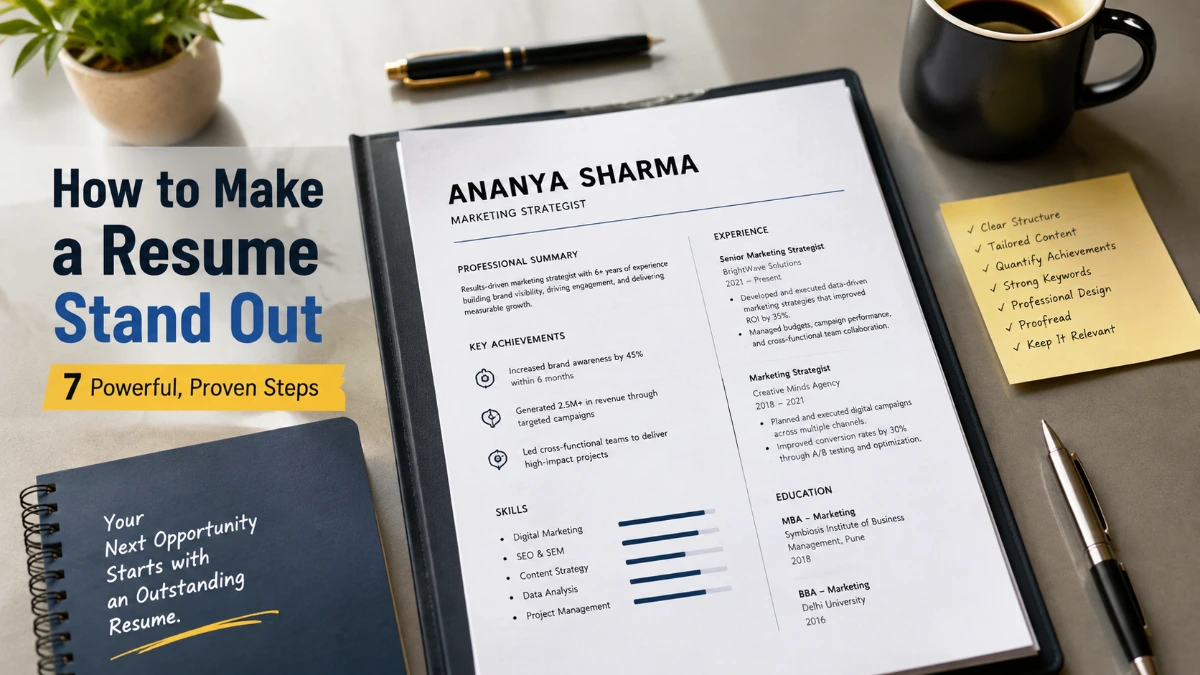
A resume stands out when an employer can quickly see three things: you understand the role, you have evidence of relevant ability, and your document is easy to review. Strong resumes are selective rather than exhaustive—they foreground the experience and proof that best match the job.
1. Rank the job requirements
Before editing your resume, read the job description as a decision tool. Separate the requirements into three groups:
| Requirement type | What it means | What to do |
| Essential | Required qualification, core responsibility, mandatory tool, licence, or experience | Make truthful proof easy to find near the top |
| Central | Repeated responsibility or capability that appears important to success in the role | Support it with an accomplishment bullet or relevant project |
| Preferred | Useful but non-essential experience or knowledge | Include it when you have credible evidence and space allows |
This is the foundation of how to make a resume stand out: do not give equal weight to every past task. Prioritize the qualifications the employer identifies as required and the capabilities repeated across the posting.
Create a short evidence map before writing:
| Employer need | Your supportable proof | Best location |
| Project coordination | Coordinated a six-person launch schedule | Experience bullet |
| Spreadsheet reporting | Built a weekly reporting tracker | Skills section and experience bullet |
| Client communication | Presented updates for 20 client accounts | Experience bullet |
| Relevant certification | Completed a recognised analytics course | Certifications section |
Use the employer’s terminology only when it truthfully describes your work, projects, training, or education. Berkeley Career Engagement advises candidates to analyse the position description, identify required and preferred qualifications, and tailor accomplishments to the employer’s needs.
2. Replace duties with evidence
The clearest answer to how to make a resume stand out is to turn a duty list into a proof of contribution. A job title alone does not explain your level of responsibility or the difference your work made.
Use this practical pattern:
Action + work or problem + scope/context + outcome or useful deliverable
| Duty-led bullet | Evidence-led bullet |
| Responsible for social media | Planned and scheduled campaign content across three channels, supporting an increase in event registrations |
| Managed customer queries | Resolved email and chat queries while documenting recurring issues for the product team |
| Assisted with reports | Built a weekly performance report that gave managers a clearer view of campaign activity |
An outcome does not have to be a percentage, revenue figure, or cost-saving claim. It can be a completed deliverable, a clearer process, a supported decision, a resolved issue, a trained group, or an organised workflow. Use a number when it accurately explains scale, volume, time, audience, budget, or change—but never manufacture a metric.
Texas State Career Services recommends action verbs and quantifying people, products, or profits where possible, while Berkeley advises candidates to focus on the outcomes of their efforts.
3. Put the strongest evidence first
Knowing how to make a resume stand out also means controlling what the reader sees first. Your most relevant proof should not be hidden below older, less relevant work or a long skills list.
A conventional sequence works for many applications:
- Contact details, including a professional email address
- Optional targeted headline or short summary
- Relevant skills
- Experience, projects, research, internships, or volunteer work
- Education, certifications, and selected additional information
Use a summary only when it clarifies your fit immediately—for example, when you are changing careers, have a defined specialism, or bring several years of relevant experience. Avoid vague claims such as “results-driven professional” unless the rest of the sentence identifies the type of work, expertise, or outcome you can support.
Example summary
Operations coordinator with experience organising cross-team workflows, maintaining reporting systems, and improving administrative processes for service-focused teams.
For early-career applicants, a project or education section may carry more persuasive evidence than a generic summary. Berkeley notes that resumes can include work, research, volunteer, and project experience alongside education and skills.
4. Match skills with proof
Job-description keywords matter, but a skills list by itself rarely makes a convincing case. The more useful approach is to pair an important term with an example showing where you used it.
For how to make a resume stand out in an online application, identify the job’s repeated skills, systems, tools, credentials, and responsibilities. Then use only the language you can explain truthfully in an interview.
For example:
| Job-post term | Weak use | Stronger use |
| Stakeholder communication | “Stakeholder communication” in a skills list | “Prepared weekly project updates for internal stakeholders and incorporated feedback into launch plans” |
| Excel reporting | “Excel” in a skills list | “Built an Excel tracker to consolidate weekly activity data for team reporting” |
| Customer service | “Customer service” in a skills list | “Resolved customer queries across email and chat and recorded recurring issues for follow-up” |
Use recognisable headings such as Experience, Education, and Skills. Grinnell College’s career guidance recommends basic headings and warns applicants not to overload a resume with copied keywords.
5. Choose clarity over decoration
A resume should be simple to scan and practical to submit. In conventional online applications, elaborate design can obscure information or create problems when text is extracted into an application system.
Use a readable font, consistent dates, clear section headings, and concise bullets. Keep employer name, job title, location where relevant, and dates visually distinct. Use reverse chronological order unless another approach gives a clear, role-specific advantage.
Be cautious with:
- Tables, text boxes, graphics, charts, icons, photos, and multi-column layouts
- Overly dense pages with long paragraphs
- Decorative templates that leave little room for evidence
- Inconsistent type sizes, date formats, verb tenses, or punctuation
When deciding how to make a resume stand out, follow the employer’s stated file-format instructions. If an application portal provides a preview or parses your resume into fields, inspect it before submitting; check that headings, dates, and experience appear correctly. If no format is specified, keep a clean PDF and an editable DOCX version ready, because employer workflows and application systems vary.
For design-led roles, a conventional text-forward resume can still be the safer document for an online portal. Demonstrate visual work through a curated portfolio unless the employer specifically requests another format.
6. Use projects and portfolios selectively
A project can strengthen your application if it demonstrates a skill that your work history does not yet show. This is useful for students, career changers, freelancers, developers, designers, writers, researchers, and applicants with limited formal experience.
For each project, explain:
- The problem, brief, or objective
- Your specific contribution
- The tools, methods, or skills used
- The result, decision, deliverable, or learning outcome
A portfolio link should give a reviewer direct, relevant evidence—not another task. Choose a small number of polished samples, label them clearly, test every link, and remove outdated or unfinished work.
Texas State’s portfolio guidance recommends selecting only material needed for the career objective, tailoring samples to the role, and choosing concrete evidence of skills.
7. Review for credibility before submission
The final stage of how to make a resume stand out is quality control. A tailored document loses force if it contains errors, unsupported claims, broken links, or inconsistent formatting.
Use this final review:
- Is the target role clear in the top third of the first page?
- Are the essential job requirements supported by truthful evidence?
- Does each major bullet show an action, contribution, scope, outcome, or useful deliverable?
- Are key skills shown both in the skills section and, where possible, in experience or projects?
- Are your titles, dates, employers, qualifications, and metrics accurate?
- Are headings conventional, and is the layout easy to scan?
- Have you followed every application instruction, including the requested file format?
- Are the portfolio, LinkedIn, and work-sample links professional and working?
- Have you removed irrelevant or repetitive content?
- Has a careful second reader reviewed the document for clarity and errors?
A second reader can identify wording that makes sense to you but lacks context for an employer. Texas State Career Services advises applicants to get feedback because another reviewer can spot unclear wording and formatting errors.
Adapt the approach
Students and new graduates
Use academic projects, internships, coursework, volunteer work, part-time roles, research, student organisations, and leadership responsibilities when they demonstrate relevant capability. Focus on your contribution, not whether the experience was paid.
Career changers
Translate previous responsibilities into the language of the new role. A retail supervisor may have evidence of staffing, customer problem-solving, scheduling, training, reporting, and operations. A teacher may have evidence of communication, facilitation, planning, stakeholder management, and data-informed improvement.
Experienced applicants
Prioritize recent, role-relevant work. Reduce detail for older positions unless they establish a qualification important to the target role. The resume should be a focused case for fit, not a complete employment archive.
Applicants without numbers
Use credible scope instead of invented results. Describe the process you improved, the audience you supported, the tool you used, the deliverable you created, the decision you informed, or the responsibility you held.
Mistakes that weaken a resume
Avoid these common errors:
- Sending the same untailored resume to every employer
- Giving every old role and task equal prominence
- Copying keywords you cannot support or explain
- Listing duties without concrete contribution or outcome
- Using a summary filled with generic adjectives
- Treating the skills section as evidence by itself
- Using complicated formatting for a standard online application
- Ignoring the employer’s instructions
- Adding an outdated, incomplete, or irrelevant portfolio
- Leaving inconsistencies in dates, tense, punctuation, or spelling
A resume becomes more compelling when it makes a believable connection between the employer’s needs and your documented experience. It cannot guarantee an interview, but it can make your relevant qualifications easier to understand and assess.
Frequently Asked Questions
There is no single correct length. A concise one-page document may fit many students and early-career applicants, while professionals with substantial relevant experience may need more space. Keep the focus on relevance, clarity, and any instructions from the employer.
Yes, at least in meaningful ways. Prioritize different evidence, adjust the summary if used, align truthful terminology with the role, and remove information that does not help the employer assess fit.
No. Systems and employer workflows vary. Use straightforward text, standard headings, and the file type requested in the posting; where available, inspect the portal’s parsed preview before submitting.
Follow the employer’s local norms and instructions. Do not add a photo merely for decoration, and use the space for job-relevant evidence when a photo is not expected.
A template can save time if it leaves enough room for tailored evidence and remains easy to read. Avoid templates that depend on graphics, dense columns, or unusual formatting in a conventional online application.
Include one when it allows an employer to review your best relevant work, such as writing samples, designs, code, research, or case studies. Keep it curated, professional, accessible, and directly relevant to the role.