
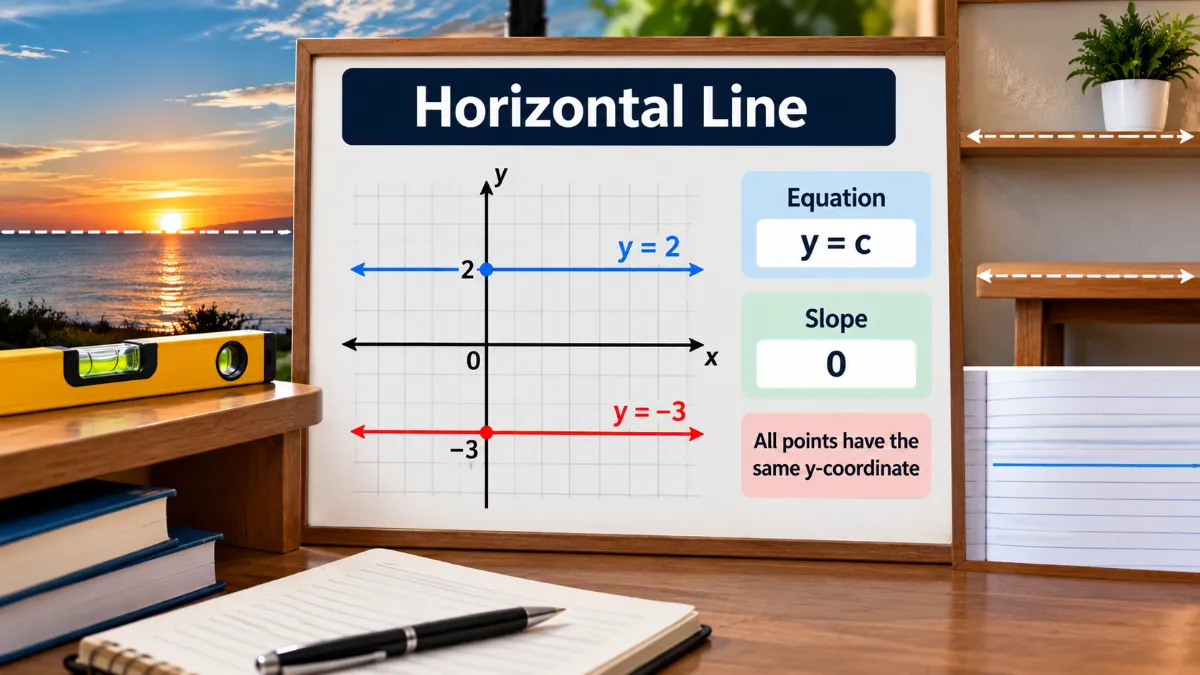
A horizontal line is a straight line that runs from left to right, parallel to the horizon. On a coordinate plane, it runs in the same direction as the x-axis and has a slope of zero. Familiar examples include a level shelf, the horizon, a flat tabletop, and the ruled lines in a notebook.
A horizontal line maintains the same height as it extends in either direction. What makes it horizontal is its orientation, not its length. A short line segment and a mathematical line extending infinitely in both directions can share the same horizontal direction.
What Is a Horizontal Line?
The horizontal line definition describes a straight line that has no upward or downward tilt.
Imagine looking across a calm ocean. The distant horizon appears to stretch from one side to the other. It’s an easy way to recognize the horizontal direction.
You can also find horizontal lines in everyday objects:
- Level shelves: A properly installed shelf extends horizontally across a wall.
- Notebook paper: Ruled paper has parallel lines that help keep handwriting straight.
- Flat tabletops: A level tabletop provides a horizontal surface.
- Window frames: The top and bottom edges of a level rectangular window frame are horizontal.
- Charts and graphs: Horizontal reference lines make it easier to compare values at the same level.
In coordinate geometry, every point on a horizontal line has the same y-coordinate, even when its x-coordinate changes. This is a fundamental property of horizontal lines on a coordinate plane.
Horizontal Line vs. Vertical Line: Key Differences
The main difference between a horizontal line and a vertical line is their direction. Horizontal lines run from left to right, while vertical lines run up and down.
Their equations, slopes, and coordinate values also differ.
| Feature | Horizontal Line | Vertical Line |
| Direction | Left to right | Up and down |
| Orientation | Level | Upright |
| Axis relationship | Parallel to or coincident with the x-axis | Parallel to or coincident with the y-axis |
| Equation | y = c | x = c |
| Slope | Zero (0) | Undefined |
| Constant coordinate | y-coordinate | x-coordinate |
| Example | y = 2 | x = 2 |
For a simple comparison, picture a level shelf and the upright edge of a wall. The shelf runs horizontally, while the wall edge runs vertically.
A diagonal line is different from both because it slants upward or downward as it moves from left to right. Unlike a horizontal line, a straight diagonal line has a nonzero, defined slope.
These differences are especially important when working with horizontal and vertical line equations.
What Is the Equation of a Horizontal Line?
The standard horizontal line equation is:
y = c
Here, c represents a constant, or a fixed number. Every point on the line has that same y-coordinate.
The x-coordinate can take any real value without changing the line’s height. That’s why the equation doesn’t need an x-term.
Example 1: Horizontal Line y = 2
Consider the equation:
y = 2
Every point on this line must have a y-coordinate of 2.
For example:
- (−2, 2)
- (0, 2)
- (3, 2)
Plot these points on a coordinate plane and connect them with a straight line. The result is a horizontal line two units above the x-axis.
It crosses the y-axis at (0, 2), which is its y-intercept.
Example 2: Horizontal Line y = −3
Now consider:
y = −3
Some points that satisfy this equation are:
- (−2, −3)
- (0, −3)
- (3, −3)
Notice that every point has a y-coordinate of −3. When plotted, they form a horizontal line three units below the x-axis.
Even though the y-value is negative, the slope remains zero.
The x-axis is itself a horizontal line, represented by y = 0.
These examples follow the basic equation of a line, where the slope and the y-intercept determine its position on a coordinate plane.
Why Is the Slope of a Horizontal Line Zero?
The slope of a horizontal line is always zero because its height doesn’t change as you move from left to right.
Slope measures vertical change compared with horizontal change, often called rise over run.
The formula for calculating slope between two distinct points is:
m = (y₂ − y₁) / (x₂ − x₁)
Here, m represents the slope, while the two coordinate pairs identify points on the line.
Let’s calculate the slope between (0, 2) and (3, 2).
Substitute the coordinates into the formula:
m = (2 − 2) / (3 − 0)
m = 0 / 3 = 0
The y-coordinate remains 2 at both points, so the vertical change is zero. As a result, the slope is zero.
Vertical lines behave differently. Their x-coordinates remain constant, so the horizontal change is zero. Calculating their slope would require division by zero, which is undefined.
This distinction is covered in the explanation of slope in elementary algebra.
Remember: Horizontal lines have zero slope, while vertical lines have undefined slope.
How to Draw and Graph a Horizontal Line
You can draw a horizontal line on ordinary paper with a ruler or graph one using a coordinate plane.
How to Draw a Horizontal Line Using a Ruler
- Place a sheet of paper on a flat surface.
- Position your ruler straight across the page, parallel to its top or bottom edge.
- Hold the ruler steady and draw along its edge.
- Check that your line doesn’t tilt upward or downward.
If you’re using ruled notebook paper, its printed lines can help guide your ruler.
How to Graph a Horizontal Line
Suppose you’re asked to graph y = 2.
- Draw the x-axis and y-axis.
- Locate 2 on the y-axis.
- Mark the point (0, 2).
- Plot another point with the same y-coordinate, such as (3, 2).
- Connect the points with a straight line and extend it in both directions.
To graph y = −3, use the same steps, but place your points three units below the x-axis.
Helpful tip: Whenever an equation has the form y = c, find that fixed y-value and draw a horizontal line across the graph at the corresponding height.
Horizontal Line Examples in Everyday Life
Horizontal lines are useful far beyond classroom geometry. They appear in architecture, construction, maps, charts, and document layouts.
In architecture, level beams, shelves, and building edges help create properly aligned structures. Builders use leveling tools to make sure surfaces are horizontal rather than slightly tilted.
On maps, horizontal and vertical grid lines can work together to help identify locations. The meaning of those lines depends on the map’s coordinate system.
In charts, horizontal grid lines help readers compare values along a vertical scale. A horizontal reference line can also show a fixed target, average, or threshold.
In writing and document design, horizontal rules separate sections, making information easier to organize and read.
Whether it’s a shelf, a graph, or a document divider, the underlying idea remains the same: a horizontal line extends from side to side without rising or falling.
Read Also: Horizontal Line
Frequently Asked Questions
Are all horizontal lines parallel to each other?
Yes. On the same coordinate plane, any two distinct horizontal lines are parallel because they have the same slope of zero and never intersect. If two horizontal-line equations have the same y-value, they describe the same line rather than two separate parallel lines.
Can a horizontal line pass through the origin?
Yes. A horizontal line passes through the origin (0, 0) when its equation is y = 0. This is the x-axis, which extends horizontally through the center of the standard coordinate plane.