
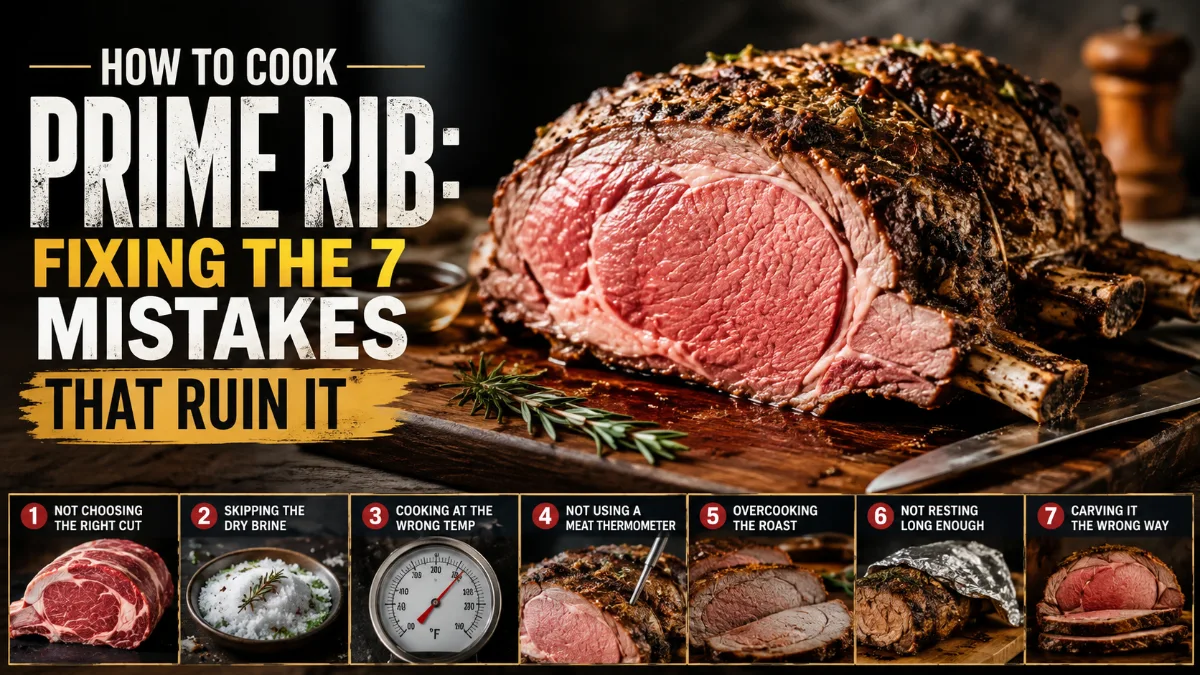
Most people don’t fail at How to Cook Prime Rib because of a bad recipe — they fail because of predictable, avoidable mistakes at four specific moments: seasoning, temperature control, resting, and carving. Fix those moments, and the rest takes care of itself. This guide is organized around exactly those failure points, with the fix for each one.
The Problem: Prime Rib Feels Like a One-Shot Gamble
A whole standing rib roast costs more than almost anything else you’ll cook at home, and it only tells you whether it’s done after you’ve already cut into it. That combination — high stakes and no do-overs — is why so many people search for How to Cook Prime Rib the night before a big dinner instead of just winging it as they would with a weeknight steak.
The good news is that the roast itself isn’t fragile; the process just needs to be followed in the right order.
Before You Cook: Know What You’re Actually Cooking
Prime rib is a standing rib roast from the rib primal, made up of several rib bones and a substantial fat cap along the top, with the kind of heavy marbling that rewards roasting whole rather than slicing into individual steaks beforehand.
Bone-In vs. Boneless Prime Rib
Buyers usually choose between bone-in and boneless, often labeled ribeye roast.
| Feature | Bone-In | Boneless |
| Structure | Includes several rib bones | No bones |
| Carving | Requires carving around the bone | Easier to carve |
| Usable meat per pound | Slightly less because of bone weight | Slightly more |
| Cooking approach | Same basic method with a small time adjustment | Same basic method |
Pick based on your priorities, not a “correct” answer. If you want easier carving and slightly more edible meat per pound, go boneless. If you want a bit more flavor and don’t mind carving around bone, go bone-in — either one follows the same method for How to Cook Prime Rib, just with a small time adjustment for the bone-in version.
How Much Prime Rib Should You Buy?
As a starting point, buy roughly one pound of bone-in roast per person, or slightly less for boneless. Size your purchase to your guest count before worrying about anything else.
What You Need
The article’s method does not require a long equipment list. The most important tools are:
- A reliable instant-read or leave-in meat thermometer
- A rack-fitted roasting pan
- Kitchen twine, if needed
- A sharp carving knife
For seasoning, use:
- Kosher salt
- Herbs of your choice
- Garlic, if desired
The thermometer is the most important piece of equipment. It removes the guesswork that comes from relying on oven timing or judging doneness by appearance.
Quick Answer: How to Cook Prime Rib
The core method is a reverse sear:
- Salt the roast ahead of time when possible.
- Let it sit at room temperature for 1 to 2 hours before cooking.
- Roast it at a low oven temperature between 200°F and 250°F.
- Monitor the internal temperature in the thickest part, away from the bone.
- Pull the roast when it is 10 to 15 degrees below your desired final temperature.
- Let the oven climb to 450°F–500°F.
- Return the roast to the oven for 10 to 15 minutes to build the crust.
- Rest the roast before carving.
- Slice against the grain.
The thermometer, rather than the clock, determines when the roast is ready.
Problem One: You Don’t Know What You’re Actually Cooking
Prime rib is a standing rib roast from the rib primal. It has several rib bones and a substantial fat cap, along with heavy marbling that makes it well suited to roasting whole.
Solution
Choose bone-in or boneless according to how you want to serve it.
Bone-in is a good choice if you don’t mind carving around the bone. Boneless is easier to carve and gives you slightly more usable meat per purchased pound.
Action
Plan the roast around your guest count. Use roughly one pound per person for bone-in, or slightly less for boneless.
Problem Two: Guessing Instead of Measuring
The biggest single reason prime rib turns out wrong is relying on a timing chart or a poke-and-guess approach instead of an actual thermometer reading.
Oven accuracy varies, roast shapes vary, and neither of those variables shows up on a generic per-pound chart.
Solution
Treat a reliable instant-read or leave-in meat thermometer as non-negotiable equipment. Pair it with a rack-fitted roasting pan, kitchen twine for tying if needed, and a sharp carving knife, and you’ve covered every tool that actually matters for How to Cook Prime Rib successfully.
Action
Buy the thermometer before the roast if you have to choose priorities — it’s the one tool with no workaround.
Problem Three: Seasoning Too Late
Salting a roast right before it goes in the oven only seasons the surface; the interior stays bland no matter how good your seasoning blend is. This is one of the most common mistakes among people who are still learning How to Cook Prime Rib for the first time.
Solution: Dry Brine
Coat the roast generously with kosher salt and any herbs or garlic you like, then leave it uncovered on a rack in the fridge.
The salt draws moisture to the surface, which reabsorbs and carries seasoning deep into the meat.
Action
Salt the roast 24 to 48 hours before cooking if your schedule allows. If not, salting even 45 minutes ahead beats seasoning at the very last second.
Problem Four: Cooking It All at One Temperature
Roasting a whole prime rib at a single high temperature from start to finish is the fastest route to a thick, overcooked gray band just beneath the crust, because the outside finishes cooking long before the center catches up.
Solution: Reverse Sear
Reverse searing means roasting low and slow first, then finishing with a short, hot sear at the very end. The goal is for the whole interior to finish at close to the same time while only the surface receives the intense heat.
This is the core method for how to Cook Prime Rib without sacrificing evenness for speed.
Action: Follow This Sequence
1. Let the roast sit at room temperature for 1 to 2 hours.
This keeps it from going directly into the oven from a cold start.
2. Roast at a low oven temperature.
Set the oven between 200°F and 250°F. Place the roast fat-side up on a rack.
3. Check the internal temperature.
Insert an instant-read thermometer into the thickest part, away from the bone. Do not rely on time alone.
4. Pull the roast early.
Once it reads 10 to 15 degrees below your target, remove it from the oven.
5. Increase the oven temperature.
Let the oven climb to 450°F–500°F.
6. Sear the roast.
Return it to the oven for 10 to 15 minutes to develop a deep crust.
Prime Rib Internal Temperature Chart
Because internal temperature continues to rise after the roast leaves the heat, pulling it at the final target temperature can cause it to overshoot during the rest.
Use this chart as your reference:
| Doneness | Pull Temperature | Final Temperature After Resting |
| Rare | 110–115°F | 120–129°F |
| Medium-rare | 120–125°F | 130–134°F |
| Medium | 125–130°F | 135–144°F |
| Medium-well | 135–140°F | 145–154°F |
| Well-done | 145–150°F | 155–164°F |
These are reliable ranges rather than exact science, and slight variation between sources is normal. When unsure, err toward pulling early.
How Do You Know When to Pull Prime Rib?
Decide your target doneness before cooking. Write down the matching pull temperature and treat that number — not the clock — as your actual stopping point.
The key principle is carryover cooking: the roast continues to rise in temperature after it leaves the oven.
Problem Five: Not Knowing When to Actually Pull It
Because internal temperature keeps rising after the roast leaves the heat, a process called carryover cooking, pulling it at your actual target temperature guarantees you’ll overshoot by the time it finishes resting.
Solution
Use the pull-temperature chart above and remove the roast before it reaches the final temperature you want.
Action
Choose the desired doneness before the roast goes into the oven. Keep the target pull temperature available while cooking so you know exactly when to remove it.
Problem Six: Carving Immediately After Pulling It Out
Cutting into a roast right after it comes out of the oven sends the juices that should stay in the meat straight onto the cutting board instead, undoing much of what the rest of the process worked to preserve.
Solution: Rest Before Carving
Tent the roast loosely with foil and let carryover cooking and juice redistribution finish before the knife comes out.
How Long Should Prime Rib Rest?
Rest a mid-sized roast for 20 to 30 minutes, and closer to 40 minutes for a very large one, before carving.
Resting is not wasted time. It is part of the cooking process.
Problem Seven: Carving It Carelessly
Even a perfectly cooked roast can feel tougher than it should if it’s sliced the wrong way relative to the muscle fibers.
Solution: Slice Against the Grain
Stand the roast on its base. If it is bone-in, cut along the bones first to free the meat in one piece. Then slice into portions about half an inch thick.
Action
Identify the direction of the grain before you start cutting, and orient every slice perpendicular to it.
Slicing against the grain shortens the muscle fibers in each bite, making the meat noticeably more tender than cutting with the grain.
How Long Does Prime Rib Take to Cook?
There is no single reliable cooking time for every roast in this method.
Oven accuracy varies, roast shapes vary, and bone-in and boneless roasts can require different timing. For that reason, the thermometer is more important than a generic minutes-per-pound chart.
Use the low-temperature range of 200°F–250°F, monitor the internal temperature in the thickest part away from the bone, and remove the roast according to the pull-temperature chart.
The final searing stage is more specific: once the roast is 10 to 15 degrees below the desired target, raise the oven to 450°F–500°F and return the roast for 10 to 15 minutes.
Should You Cover Prime Rib While Cooking?
The reverse-sear method described here calls for the roast to be fat-side up on a rack during the low-temperature roasting stage.
For dry brining, the roast is specifically left uncovered on a rack in the refrigerator for 24 to 48 hours when possible.
The key focus throughout the method is temperature control rather than covering the roast.
Should Prime Rib Be Cooked Fat-Side Up?
Yes. The low-temperature roasting sequence in this guide places the roast fat-side up on a rack.
The more important instruction, however, is to monitor the internal temperature in the thickest part of the meat rather than judging doneness from the outside.
A Faster, Imperfect Alternative
If time matters more than edge-to-edge evenness, traditional high-heat roasting — cooking the whole roast at a consistently high temperature throughout — gets you a finished result faster, though usually with a thicker overcooked band near the surface.
The same reverse-sear approach also works outdoors on a grill set up for indirect heat, using the identical low-then-sear sequence and thermometer checks.
Whichever route you take, the underlying principles behind How to Cook Prime Rib properly don’t change with the heat source.
Prime Rib Troubleshooting
The outside is overcooked while the center is less done
This can happen when the roast is cooked at a high temperature from start to finish. The outside finishes cooking before the center catches up.
The reverse-sear method reduces this problem by using low heat first and a short high-heat finish.
The roast is bland
The likely problem is seasoning too late. Dry brining with kosher salt 24 to 48 hours ahead gives the seasoning more time to work into the meat.
The roast is overcooked
The biggest protection against overshooting is monitoring internal temperature and pulling the roast before it reaches the desired final temperature.
The roast seems dry after carving
Skipping the resting period can allow juices to run onto the cutting board rather than remaining in the meat. Rest for 20 to 30 minutes for a mid-sized roast and closer to 40 minutes for a very large one.
The slices feel tougher than expected
Check the direction of the grain. Slice perpendicular to the muscle fibers rather than along them.
The crust isn’t as deep as you want
The reverse-sear method reserves the highest heat for the end. After pulling the roast 10 to 15 degrees below the target, let the oven climb to 450°F–500°F and return the roast for 10 to 15 minutes.
Rounding Out the Meal
Prime rib is rich, so simple sides work well.
Au jus made from the pan drippings and a sharp horseradish sauce both cut through the roast’s richness nicely. Simple roasted vegetables or mashed potatoes can accompany the roast without competing with the main event.
Frequently Asked Questions
Relying on a timing chart instead of a thermometer. Oven accuracy and roast shape both vary too much for time alone to be reliable.
Ideally 24 to 48 hours ahead using a dry brine. If you’re short on time, salting 45 minutes ahead still helps.
Around 120–125°F, which rises to the target 130–134°F range after resting because of carryover cooking.
Yes, for evenness. High-heat-only methods tend to leave a thicker overcooked band near the surface compared with reverse searing.
About 20 to 30 minutes for a mid-sized roast, and up to 40 minutes for a very large roast.
Bone-in needs a bit more time due to the insulating bone. Boneless carves more easily and yields slightly more meat per pound
Juices that should redistribute through the meat instead run out onto the cutting board, leaving a drier result.
Yes. Use indirect heat and the same low-temperature-then-sear sequence, monitoring internal temperature the same way.
Slicing against the grain shortens the muscle fibers in each bite, making the meat noticeably more tender than cutting with the grain.
Don’t treat prime rib as a race against the clock. Choose your roast, season it ahead when possible, control the cooking temperature, monitor the internal temperature, pull it early enough to account for carryover cooking, rest it properly, and carve against the grain.