
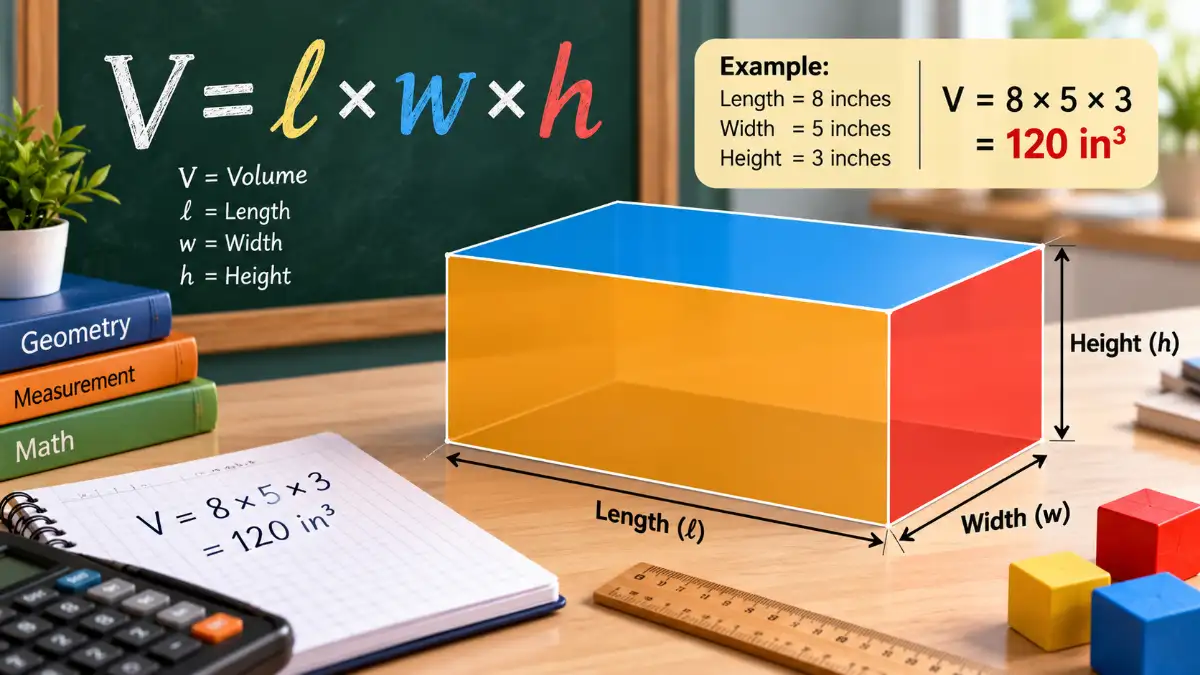
Rectangular prism volume is the amount of three-dimensional space inside a rectangular prism. To calculate it, multiply the prism’s length, width, and height using the formula V = l × w × h. For example, a rectangular prism measuring 8 inches long, 5 inches wide, and 3 inches high has a volume of 8 × 5 × 3 = 120 cubic inches (in³).
This formula works for rectangular boxes, storage containers, and other right rectangular prisms. Before multiplying, make sure all three dimensions use the same measurement unit. The final answer should always be expressed in cubic units.
What Is the Volume of a Rectangular Prism?
The volume of a rectangular prism tells you how much three-dimensional space it occupies. A rectangular prism has six rectangular faces, with its length, width, and height meeting at right angles.
One way to understand volume is to imagine filling the prism with small, equally sized cubes. Each cube measures one unit along every edge and occupies one cubic unit of space. The number of cubes needed to fill the prism without gaps represents its volume.
For example, a rectangular prism that holds 24 one-inch cubes has a volume of 24 cubic inches. This relationship between volume and unit cubes is an important foundation for understanding three-dimensional measurement.
Volume is expressed in cubic units, including:
- Cubic inches (in³): Commonly used for small boxes and objects.
- Cubic feet (ft³): Useful for larger containers and storage spaces.
- Cubic centimeters (cm³): Often used in metric geometry problems.
- Cubic meters (m³): Suitable for larger spaces and objects.
Rectangular Prism Volume Formula
The rectangular prism volume formula is:
\[ \boxed{V=l\times w\times h} \]
Where:
- V = Volume
- l = Length
- w = Width
- h = Height
Length, width, and height are the prism’s three perpendicular dimensions. It doesn’t matter which horizontal edge you call the length or width, since changing the order of multiplication does not affect the result.
How to Find the Volume of a Rectangular Prism
You can find the volume of a rectangular prism in four steps:
- Identify the dimensions. Determine the prism’s length, width, and height.
- Check the measurement units. Convert any dimensions that use different units.
- Multiply the three dimensions. Use length × width × height.
- Label your answer correctly. Express the result in cubic inches, cubic feet, or another appropriate cubic unit.
For example, suppose a rectangular prism measures 10 feet long, 4 feet wide, and 3 feet high.
Substitute these dimensions into the formula:
V=1043
\[ \boxed{V=120\text{ ft}^3} \]
The prism occupies 120 cubic feet of space.
Rectangular Prism Volume Examples
The same formula applies whether the dimensions are whole numbers, decimals, or fractions. Let’s work through three examples to see how the calculations differ.
Example 1: Volume With Decimal Measurements
A rectangular container measures 4.5 feet long, 2 feet wide, and 3 feet high.
Multiply the three dimensions:
V=4.523
\[ \boxed{V=27\text{ ft}^3} \]
The container has a geometric volume of 27 cubic feet. Decimal measurements do not change the formula; you simply multiply them as usual.
Example 2: Volume With Fractions
Suppose a rectangular prism has the following dimensions:
- Length = 3/2 feet
- Width = 2 feet
- Height = 1/2 foot
Substitute these measurements into the volume formula:
V=32212
\[ \boxed{V=1.5\text{ ft}^3} \]
The volume is 1.5 cubic feet.
When working with fractions, multiply the numerators and denominators, then simplify the result. You can also convert the fractions into decimals before multiplying.
Example 3: Shipping Box Volume
Imagine a shipping box with internal dimensions of 12 inches long, 8 inches wide, and 6 inches high.
Calculate its volume:
V=1286
\[ \boxed{V=576\text{ in}^3} \]
The box provides 576 cubic inches of internal geometric space.
For storage and packaging calculations, use the box’s internal dimensions rather than its outside measurements. Keep in mind that packaging materials and the shapes of stored objects can reduce the amount of usable space.
Alternative Formula: Base Area × Height
Another way to calculate rectangular prism volume is to multiply the area of its base by its height.
The formula is:
\[ \boxed{V=B\times h} \]
Here, B represents the area of the rectangular base.
Since the area of a rectangle equals length × width:
B=lw
Substituting this into the volume formula gives:
V=(lw)h
Both methods produce the same result.
For example, consider a rectangular prism with a base measuring 6 cm by 4 cm and a height of 5 cm.
First, calculate the base area:
Base area = 6 × 4 = 24 cm²
Then multiply by the height:
Volume = 24 × 5 = 120 cm³
This approach makes sense when you picture the prism as layers of equal area stacked through its height. The base-area method and the length × width × height formula are simply two ways of expressing the same calculation.
How to Find a Missing Dimension
Sometimes a geometry problem gives you the volume and two dimensions but asks you to calculate the third.
You can solve these problems by rearranging the volume formula.
To find the length:
l=Vwh
To find the width:
w=Vlh
To find the height:
h=Vlw
Suppose a rectangular prism has a volume of 96 cubic inches, a length of 8 inches, and a width of 4 inches.
To calculate its height, divide the volume by the product of the length and width:
h=9684
\[ h=\frac{96}{32}=\boxed{3\text{ inches}} \]
The missing height is 3 inches.
Remember that volume is measured in cubic units, while length, width, and height are measured in linear units such as inches or centimeters.
Converting Units Before Calculating Volume
Before calculating volume, check whether all three dimensions use the same measurement unit.
For example, a storage container has these dimensions:
- Length = 2 feet
- Width = 12 inches
- Height = 6 inches
Because the measurements use both feet and inches, convert the length into inches first.
2 feet = 24 inches
Now calculate the volume:
V=24126
\[ \boxed{V=1,728\text{ in}^3} \]
Since 1 cubic foot equals 1,728 cubic inches, the container’s volume is also 1 ft³.
Here are some useful conversions:
- 1 foot = 12 inches
- 1 ft³ = 1,728 in³
- 1 meter = 100 centimeters
- 1 m³ = 1,000,000 cm³
These relationships agree with the official volume conversion tables used for US customary and metric measurements.
A common mistake is multiplying by 12 when converting cubic feet to cubic inches. Because volume involves three dimensions, the correct conversion factor is 123, or 1,728.
How to Use a Rectangular Prism Volume Calculator
You can calculate volume with a basic calculator or a dedicated rectangular prism volume calculator.
With a basic calculator, enter the length, multiply it by the width, and multiply that result by the height. Make sure every measurement uses the same unit.
A dedicated volume calculator generally asks for the three dimensions and their measurement units, then calculates the volume automatically.
For example, suppose you enter:
- Length = 7 cm
- Width = 4 cm
- Height = 2 cm
The calculation is:
\[ 7\times4\times2=\boxed{56\text{ cm}^3} \]
The result is 56 cubic centimeters.
If your dimensions use different measurement units, convert them before entering the values unless the calculator supports mixed-unit measurements.
Rectangular Prism Volume vs. Surface Area
Volume and surface area describe different properties of a three-dimensional object.
Volume measures the space occupied by the prism and is expressed in cubic units, such as cm³.
Surface area measures the combined area of the prism’s six faces and is expressed in square units, such as cm².
For example, a box might have a volume of 120 cubic inches, while its surface area would be a separate measurement expressed in square inches.
Understanding the difference between volume and surface area helps prevent mistakes when solving geometry problems.
Practice Problems With Answers
Try solving these rectangular prism volume problems on your own before checking the answers.
Problem 1: A rectangular prism measures 7 cm long, 4 cm wide, and 2 cm high. Find its volume.
Answer:
\[ 7\times4\times2=\boxed{56\text{ cm}^3} \]
Problem 2: A storage container measures 2.5 meters long, 4 meters wide, and 3 meters high. What is its volume?
Answer:
\[ 2.5\times4\times3=\boxed{30\text{ m}^3} \]
Problem 3: A rectangular prism has a volume of 96 in³, a length of 8 inches, and a width of 4 inches. Find its height.
Answer:
\[ 96\div(8\times4)=\boxed{3\text{ inches}} \]
Read Also: Rectangular Prism Volume
Frequently Asked Questions
Is a cube a rectangular prism?
Yes. A cube is a special type of rectangular prism with equal length, width, and height. Because all its edges have the same length, its volume can be calculated using V=s3, where s represents the length of one edge.
Can two rectangular prisms have the same volume but different dimensions?
Yes. Rectangular prisms can have different dimensions while occupying the same amount of space. For example, a prism measuring 2 × 3 × 4 units and another measuring 1 × 4 × 6 units both have a volume of 24 cubic units. Their shapes may differ, but their volumes are equal.