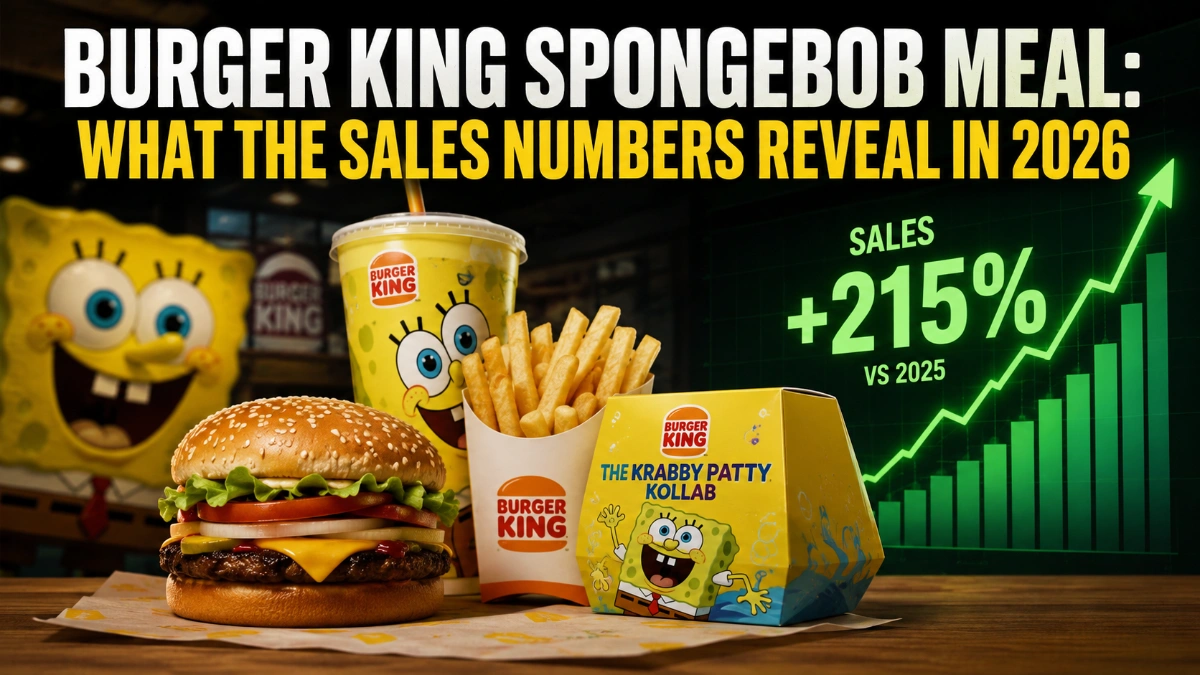
Five menu items, six collectible toys, and a same-store sales lift of 2.6% in the quarter it launched — the Burger King SpongeBob meal generated real, measurable business impact before it ran into the shortages that defined its second act. The numbers behind both halves of that story explain this campaign better than any single taste review could.
If you’re searching this now, in mid-2026, the practical question has shifted. It’s no longer “what’s in it” — it’s “did it actually work, and can I still get it.”
What the Original Numbers Looked Like
The Burger King SpongeBob meal launched nationwide on December 2, 2025, with five distinct items and a pricing structure wider than most national promotions carry. Understanding those original numbers is the baseline for understanding everything that happened next.
The Full Price Breakdown
Each item carried a standalone price, but the real commercial bet was the bundle. Here’s how it broke down at launch:
| Item | Individual Price |
| Krabby Whopper | ~$6.99 |
| Cheesy Bacon Tots (8-pc) | ~$1.99–$3.89 |
| Star-Berry Shortcake Pie | ~$2.99 |
| Pineapple Float | ~$2.59 |
| Bikini Bottom Bundle (all four) | $14.99–$19.99 |
Why the Bundle Pricing Spread Mattered
That gap between the cheapest and priciest bundle wasn’t a pricing error. Franchise owners set menu prices independently within Burger King’s national guidelines, and regional cost-of-goods differences drove most of the variation, which is standard industry practice that rarely gets explained when customers compare notes online.
The Business Numbers Prove This Worked — At First
This is the part most coverage skipped entirely. Burger King’s parent company reported that U.S. same-store sales grew 2.6% in the quarter covering the launch, with CEO Josh Kobza specifically crediting the SpongeBob campaign alongside value-menu offerings for the lift.
Kids’ Meals Hit a Decade High
Kobza also stated that kids’ meal incidence reached its highest level in ten years during the promotion, and that Burger King retained a meaningful share of the new customers the campaign attracted well into January 2026. That’s a genuinely strong result, and it’s the clearest evidence that the creative concept behind this menu was the right call — the failure that followed wasn’t a demand problem, it was a supply one.
The Nutrition Numbers Behind the Bundle
Calorie and sodium figures rarely make headlines during a hype-driven launch, but they matter here given how calorie-dense the full order actually runs.
A Full Nutritional Snapshot
| Item | Calories | Sodium |
| Krabby Whopper | 780 kcal | 1,620mg |
| Cheesy Bacon Tots | 260 kcal | 990mg |
| Star-Berry Pie | 260 kcal | 220mg |
| Pineapple Float | 250 kcal | 110mg |
| Full Bundle Total | ~1,550 kcal | ~2,940mg |
The Sodium Figure Worth Remembering
Nearly 3,000 milligrams of sodium in one order sits close to a full adult daily intake, packed into food most customers treated as a fun, one-off order rather than a full nutritional commitment. That’s a legitimate reason to treat this as an occasional order, not a case for avoiding it outright.
The Number That Actually Defines the Second Half of This Story
Within roughly a week of the December 2 debut, multiple locations began running short, and the promotion was pulled from mobile ordering on platforms including DoorDash at several restaurants. But the more accurate picture, based on widespread customer reports through December and January, is uneven rather than uniform — this wasn’t a single clean shutdown.
How the Shortage Actually Unfolded, Location by Location
Some customers reported finding the Krabby Whopper available at noon and gone entirely by 5 p.m. at the same restaurant, with staff unable to confirm whether it had ever been in stock that day. By January 2026, several locations still had the Krabby Whopper’s yellow bun in circulation while the Bikini Bottom Bundle, pineapple float, and pie had already run out weeks earlier — meaning the meal didn’t vanish all at once, it degraded item by item.
Why the Shortage Happened So Quickly
Distribution planning underestimated real demand relative to the sales lift it was generating, and Burger King never announced a fixed end date, describing the run only as available “while supplies last.” That open-ended framing meant each location’s stock depleted on its own timeline, participation became store-by-store discretionary, and customers had no consistent way to plan around it.
The One Deliberate Comeback
Burger King brought the Krabby Whopper back on its own terms for a single Buy One, Get One Free deal through the app around the movie’s December 19, 2025 theatrical release, limited to Royal Perks members. That was a sharp, low-risk move — it re-engaged fans around the premiere without requiring a full restock of the five-item menu nationwide.
The Toy Numbers: Six Characters, Uneven Odds
Six collectible toys shipped with the King Jr. Meal — SpongeBob, Patrick, Mr. Krabs, Squidward, Gary the Snail, and the Flying Dutchman — assigned randomly per order with no way to select a character at checkout.
The Real Math Behind Completing a Set
Statistically, collecting all six from a random pool typically takes closer to ten or eleven total purchases once duplicates are factored in. That math never mattered for most families in practice, since the shortages cut most locations’ toy stock short well before anyone got close to a full set.
Is the Burger King SpongeBob Meal Still Available Now
Availability is inconsistent rather than gone everywhere. As of mid-2026, most locations have discontinued the full bundle, but scattered restaurants continue serving the standalone Krabby Whopper on its themed bun long after the rest of the menu disappeared, according to ongoing customer reports.
What to Check Before Assuming It’s Gone Everywhere
Contacting a specific restaurant directly remains more reliable than checking the app, since participation has become a store-by-store decision rather than a centralized national policy. Burger King has not confirmed any full restock or second wave as of mid-2026.
Burger King’s Numbers vs Wendy’s Earlier Bet
Wendy’s ran a smaller SpongeBob promotion in October 2024, and comparing the two campaigns’ numbers shows exactly how scale changed the outcome.
| Factor | Burger King (2025) | Wendy’s (2024) |
| Menu Size | 5 items + toys | 1 burger, 1 shake |
| Bundle Price | $14.99–$19.99 | ~$10.69 |
| Same-Store Sales Impact | +2.6% (Q4 2025) | Not publicly disclosed at this scale |
| Reported Shortages | Widespread, uneven, weeks-long | Minimal |
What the Comparison Actually Proves
Wendy’s simpler, single-item approach had fewer points where things could break, and it ran its intended course without major disruption. Burger King’s bigger bet delivered a measurably stronger sales result but paid for it with a longer, messier real-world rollout — and that trade-off is the clearest strategic lesson for any chain planning a similarly ambitious tie-in.
What These Numbers Mean Going Forward
Pulling the sales data, pricing, nutrition, and shortage timeline together tells a more complete story than either the launch-week hype coverage or the complaint threads captured individually. The Burger King SpongeBob meal was a commercially successful campaign undone by a distribution miscalculation, not a demand or creative failure.
The Number Worth Remembering Most
If there’s one figure to take away, it’s the 2.6% same-store sales lift, not the shortage complaints that dominated social media. That number is the actual verdict on whether this promotion worked — everything else is a story about execution catching up to demand it clearly earned.
Frequently Asked Questions
Yes — Burger King’s parent company reported a 2.6% same-store sales increase in the U.S. during the launch quarter, with kids’ meal orders reaching their highest level in ten years.
Availability is inconsistent rather than fully discontinued — most locations have dropped the full bundle, but some still serve the standalone Krabby Whopper on request.
The bundle ran between $14.99 and $19.99 depending on location, with individual items like the Krabby Whopper priced separately around $6.99.
Distribution planning underestimated demand relative to the sales lift it generated, and with no fixed end date announced, each location’s stock ran out on its own schedule.
The complete bundle totals roughly 2,940 milligrams of sodium, close to a full day’s recommended adult intake in one order.
Yes — a Buy One, Get One Free Krabby Whopper deal ran through the app around the movie’s December 19, 2025 release for Royal Perks members only.
Statistically, around ten or eleven orders due to random assignment and duplicates, though most locations ran out of toy stock before that became relevant.
Wendy’s ran a smaller, single-item promotion that completed its full run without major disruption, while Burger King’s larger rollout delivered stronger sales but messier execution.
No — the yellow bun was a cosmetic change, and the calorie and sodium content stayed close to a standard Whopper.
No relaunch has been confirmed as of mid-2026, though the campaign’s proven sales impact makes a future encore plausible.
Contacting a specific restaurant directly is more reliable than the app, since participation is now a store-by-store decision rather than a national policy.