
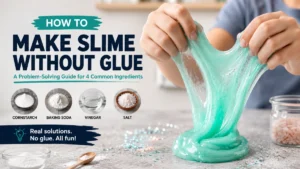
It’s a familiar moment: a child wants to make slime right now, and there’s no glue in the house. The good news is that how to make slime without glue is a solved problem with several reliable paths, each built from ingredients most homes already have — cornstarch, shampoo, dish soap, salt, or psyllium husk.
The Problem: No Glue, No Borax, Still Want Slime
Traditional slime recipes lean on white school glue for stretch and borax as an activator to bind it into a gel. Without either ingredient, the usual approach falls apart, which is exactly why so many people search for how to make slime without glue in the first place — usually mid-project, with a bored kid waiting.
The upside of this constraint is that glue-free methods also skip borax entirely, and borax has been linked to skin irritation with repeated or prolonged contact, especially for children with eczema, cuts, or otherwise broken skin. So the workaround isn’t just a substitute — it removes a minor safety concern along with the missing ingredient.
The Solution: Four Ingredient-Based Methods
Learning how to make slime without glue really comes down to picking the right substitute ingredient. Each solution below solves the same problem — no glue, no borax — using a different base ingredient, so the right pick depends on what’s already in the kitchen or bathroom cabinet.
Solution 1: Cornstarch and Shampoo. This gets closest to classic glue-based slime texture, since cornstarch acts as a binding thickener much like glue’s polymer does. Thick gel shampoo or a 3-in-1 formula works better than thin, watery shampoo, which produces a looser, less stretchy result regardless of how much cornstarch is added.
Combine half a cup of thick shampoo with two and a half cups of cornstarch in a large bowl, stirring until it forms a crumbly paste. Water needs vary by shampoo brand, so add it gradually: start with about a quarter cup, one tablespoon at a time, and go up to three-quarters of a cup total until the mixture turns smooth and slightly stretchy rather than crumbly. Adding water too fast is the single biggest mistake in this method for how to make slime without glue, since the mixture can jump from crumbly straight to runny with barely a usable stage in between.
Once it holds together, knead by hand for a minute or two, and stir in food coloring before the cornstarch goes in for even color distribution.
Solution 2: Cornstarch and Dish Soap. This is the more forgiving entry point because the ratio tolerates small measurement errors without falling apart — a practical advantage for a first attempt. Mix half a cup of cornstarch with one-third cup of liquid dish soap, working the soap in gradually with a spoon or your hands over about five minutes.
The result lands somewhere between playdough and true slime: moldable, mildly stretchy, and more satisfying to squish than to stretch long. If it’s too sticky, add more cornstarch; if it won’t hold together, work in a few more drops of soap. Thicker dish soap brands tend to finish smoother than watery ones.
Solution 3: Shampoo, Dish Soap, and Salt. This is the fastest solution here, since it skips cornstarch entirely and uses salt’s osmotic pull to thicken the mixture, though it comes at the cost of durability. Squeeze a generous amount of shampoo into a bowl, add a similarly sized squirt of dish soap, then stir in a pinch of salt, and place the bowl in the freezer for 20 minutes.
It firms up enough to handle once it’s out of the freezer, but softens again quickly as it warms in your hands. This recipe is based on a single tested source rather than several independently cross-checked accounts, so it’s best treated as a quick experiment rather than a batch meant to last more than one sitting.
Solution 4: Psyllium Husk (Best for Toddlers). This fourth path to how to make slime without glue trades some stretchiness for safety. Unlike the soap-based solutions above, this one uses a food-grade fiber powder, making it the safer choice when young children are likely to put their hands or the slime itself in their mouths.
Microwave three tablespoons of psyllium husk with about one and two-thirds cups of water for up to five minutes, stirring every minute until it turns thick and gel-like, then let it cool for a full hour before handling since it comes out very hot. As with the salt method, this ratio comes from a single documented source, so results may shift slightly depending on microwave wattage. Once cooled, it has a distinctly jelly-like stretch, and while it’s food-grade, it still isn’t meant to be eaten as a snack.
The Action: What to Do After the Slime Is Made
Solving how to make slime without glue is only half the job — keeping a batch usable and safe takes a few follow-up actions.
Fix texture problems immediately. This is the part of how to make slime without glue that trips up most first-timers. Most failures reduce to two issues: too sticky or too runny. For stickiness, work in a small amount of extra cornstarch at a time. For runniness, add more cornstarch for the shampoo or dish soap versions, or return the salt-based mixture to the freezer for another 5 to 10 minutes. Overcorrecting with one large addition is the most common mistake — small, incremental adjustments work better.
Store it properly, and expect it to fade faster than glue slime. Glue-free slime generally has a shorter shelf life than traditional glue-and-borax slime. Cornstarch-based batches typically dry out within a day or two of regular play, while the shampoo-and-salt version separates fastest of all, sometimes within a single session. Store any batch in an airtight container or a zip-top bag with the air pressed out, at room temperature and away from direct sunlight; a few drops of water kneaded in can temporarily revive a drying batch, though every glue-free recipe eventually breaks down and needs remaking.
Apply extra caution around young children. The psyllium husk and plain cornstarch-and-water combinations are the safer choices for toddlers, since dish soap and shampoo can irritate eyes and shouldn’t be ingested. Keep glitter or small mix-ins away from children under three because of choking risk, and treat hand-washing after play as standard practice regardless of which recipe was used.
Frequently Asked Questions
The shampoo-and-salt method skips cornstarch entirely, relying on salt to thicken the mixture through osmosis, though it produces a softer, shorter-lived result.
Not enough water was worked in. Add it gradually, a tablespoon at a time, up to the recommended maximum for the method, since jumping straight to a large amount often overshoots into runniness instead.
It’s made from food-grade ingredients and is lower-risk than soap-based versions, but it isn’t formulated or intended to be eaten, so it should still be treated as a play material, not a snack.
Not significantly. The gradual water-adding step is what prevents the batch from turning runny, so rushing it increases the chance of needing to add extra cornstarch to fix an overly wet mixture.
Not according to the single tested method this recipe is based on. More salt affects thickening speed, not overall durability, and the salt-based version remains the shortest-lived of the four methods regardless.
Dish soap slime is more playdough-like and forgiving, while shampoo-and-cornstarch slime stretches closer to traditional glue-based slime, making the choice largely about desired texture.
No, food coloring is added purely for appearance and doesn’t meaningfully change texture, though it should be stirred in before the thickening ingredient for even color distribution.
Yes, since shampoo and dish soap are core ingredients, a mild scent from those products is expected and isn’t a sign the recipe went wrong.