
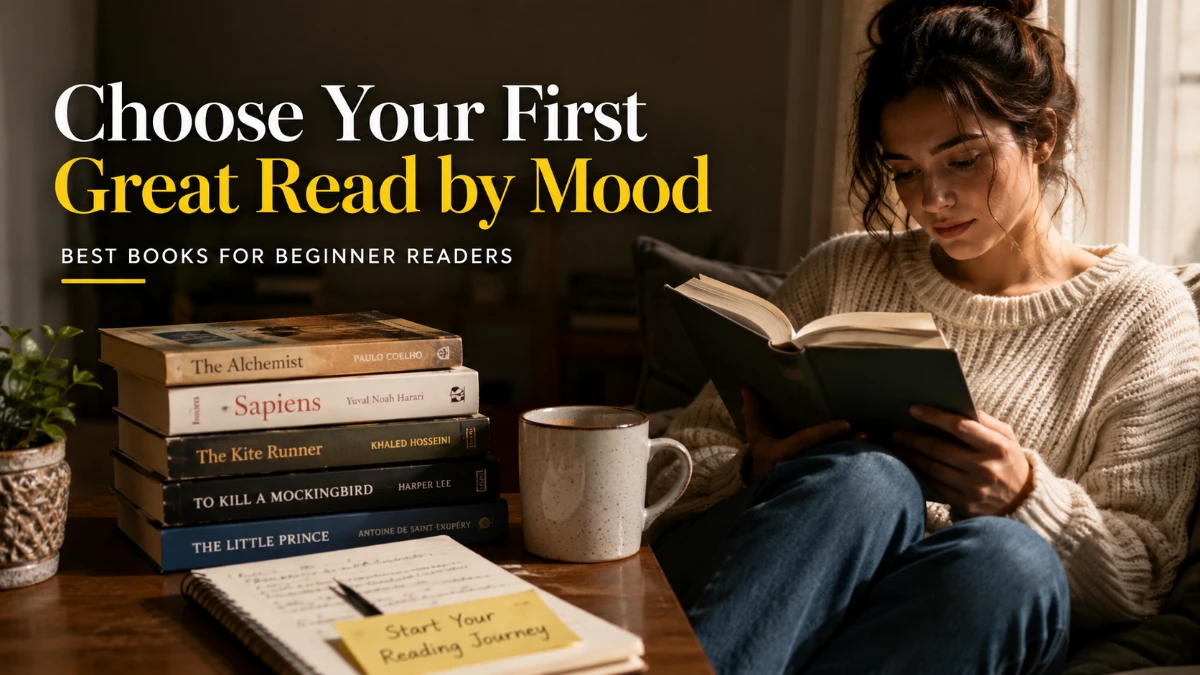
The best books for beginners to read are the ones you genuinely want to open again tomorrow. Instead of starting with a prestigious title or a huge “must-read” list, choose a book by the feeling you want from it: adventure, mystery, comfort, reflection, or useful ideas.
This guide is for teens and adults beginning or rebuilding a recreational reading habit. It is not a guide to children’s early-reading books. Print page counts can vary between formats and editions, so treat every page total as an approximate buying guide rather than a fixed measure of difficulty.
Start With the Experience
For a new reader, the best books for beginners reading solve a simple problem: they provide an immediate reason to continue. That reason might be an unanswered mystery, a funny narrator, a familiar genre, a practical takeaway, or an emotional connection with a character.
Use this short route map before choosing:
| If you want to feel… | Begin with | What makes it approachable |
| Energised | Percy Jackson and the Lightning Thief | Conversational narration, action, mythology |
| Curious | Where the Crawdads Sing | A central mystery and clear narrative question |
| Reflective | The Alchemist | Short, focused journey with simple storytelling |
| Productive | Atomic Habits | Practical chapters and clear ideas |
| Moved | A Man Called Ove or The Kite Runner | Character-led emotional stories |
| Thoughtful | The Giver or The House on Mango Street | Compact form and strong central ideas |
For Fast Adventure
Percy Jackson and the Lightning Thief by Rick Riordan
Choose this if you want a book that feels like an action film: jokes, danger, mythology, and regular movement from one scene to the next. The narrator’s informal voice makes the story feel accessible, while the opening book’s connection to a larger series gives you a ready-made next read.
The best books for beginners reading often make progress easy to notice, and this novel’s scene-based pace supports that feeling. Its exact print length differs by edition, so check the copy you are considering if a specific page count matters.
For a Mystery Pull
Where the Crawdads Sing by Delia Owens
If the strongest reason you read is to find out what happened, start here. The novel intertwines a coming-of-age story with a death investigation, creating a question that carries the reader forward.
A Penguin Random House paperback edition runs 400 pages, though other editions differ. That makes it a longer starter choice, but it can be a better fit than a shorter book for readers who already enjoy atmospheric crime dramas and want a plot that keeps moving.
For a Short, Reflective Story
The Alchemist by Paulo Coelho
The Alchemist is a sensible choice when you want to finish a novel quickly without choosing a children’s book or a lightweight story. Most editions run about 160 to 210 pages and follow one central journey, so the reader does not need to track a large cast or several plot lines.
It is best for readers who like personal-growth themes and symbolic storytelling. If you prefer realism, sharp humour, or a detailed mystery, one of the other best books for beginners reading may be a better match.
For Practical Ideas
Atomic Habits by James Clear
Not every beginning reader wants fiction. If you like self-improvement podcasts, productivity videos, or learning a usable skill, a practical book can create more motivation than a novel.
The publisher’s hardcover edition of Atomic Habits is 320 pages. Its chapters are organized around individual ideas rather than one continuing plot, so you can stop at a natural point and return later without losing your place.
For Short Sessions With Depth
The House on Mango Street by Sandra Cisneros
This book is ideal when uninterrupted reading time is hard to find. Its 160 pages are made up of brief vignettes, allowing readers to complete a small unit in a short sitting while still following a connected coming-of-age perspective.
The structure offers visible progress, but the themes — family, identity, belonging, and place — reward slow attention. It is a strong choice if you want concise literary writing rather than a conventional page-turning plot.
For a Clear “What If?” Story
The Giver by Lois Lowry
The Giver begins with a premise that is easy to grasp: what would society look like if it removed pain, memory, and meaningful choice? That clear question gives the book direction from the start.
A Scholastic paperback edition has 240 pages. Readers who enjoy dystopian films, speculative television, or thought experiments may find it more compelling than a realistic novel because each development tests the world’s rules.
For Heart and Character
A Man Called Ove by Fredrik Backman
Pick this if you enjoy stories about difficult people gradually becoming understandable. The book starts with a distinctive, gruff protagonist, then reveals the experiences and relationships that shape him.
Its blend of humour and emotional payoff suits readers who value people-centred stories over high-speed plotting. It may not be the quickest choice here, but it can be deeply engaging for readers drawn to family drama and character change.
For an Emotionally Intense Novel
The Kite Runner by Khaled Hosseini
The Kite Runner is for readers ready for a serious, character-driven story rather than a light escape. Its emotional stakes, family relationships, and consequences of difficult decisions give it a strong narrative line.
The 20th Anniversary Edition runs 352 pages. Although it is not the gentlest first choice because of its heavy themes, it can be an effective starting book for readers who enjoy powerful drama and are comfortable with an intense reading experience.
Make Your First Choice Easier
The best books for beginners reading do not have to be the most famous books on a shelf. A better first choice is usually the one that resembles entertainment you already choose voluntarily.
Try this decision rule:
- Choose one mood from the table above.
- Pick the title that matches an existing favourite film, show, game, podcast, or topic.
- Read a small, repeatable amount — one page, one scene, or one short chapter.
- Keep the book in the place where that reading moment naturally happens.
- If interest does not arrive after a fair opening stretch, change genre or format instead of forcing completion.
Starting with a deliberately small goal can make the habit feel less demanding. James Clear has recommended beginning with one page a day and using environmental cues, such as leaving a book where you are likely to see it.
If You Lose Interest
Choosing from the best books for beginners reading is not a test of discipline. If the first title fails to hold your attention, figure out why before choosing again.
- If the book is too slow, try mystery or adventure.
- If the language feels difficult, choose contemporary fiction or try an audiobook.
- If the story is emotionally draining, move toward humour or a lighter adventure.
- If fiction feels unmotivating, choose practical nonfiction.
- If the book seems too long, try short stories, essays, or vignette-based fiction.
The useful outcome is not finishing every book; it is discovering the pace, subject, and format that make you want to continue.
Frequently Asked Questions
Start with the book closest to your current entertainment taste. Percy Jackson and the Lightning Thief is a strong option for action and fantasy, while The Alchemist and The House on Mango Street suit readers seeking shorter books.
No. A longer book with a clear plot can be easier to finish than a short book with difficult language or slow pacing. Choose based on interest and readability, not page count alone.
It can be, especially for readers more motivated by useful ideas than stories. Its chapter-based structure makes it easier to pause and return to than a plot-heavy novel.
Yes. Young-adult fiction can be an excellent route into regular reading because it often uses direct language, focused plots, and strong forward momentum. The Giver and Percy Jackson are both accessible choices for adult beginners as well.
Not necessarily. After giving it a fair start, change genre, pacing, or format if you feel no pull to continue. A better fit is more valuable than forcing a first book to the end.
Yes. Audiobooks can make books easier to fit around commuting, walking, chores, or tired evenings. They are a valid way to experience literature and learn what types of stories keep you engaged.
Choose another title with a similar appeal: continue the Percy Jackson series after the first book, choose another mystery after Where the Crawdads Sing, or find a related practical topic after Atomic Habits. Momentum is easier to preserve when the next choice resembles what you enjoyed.