
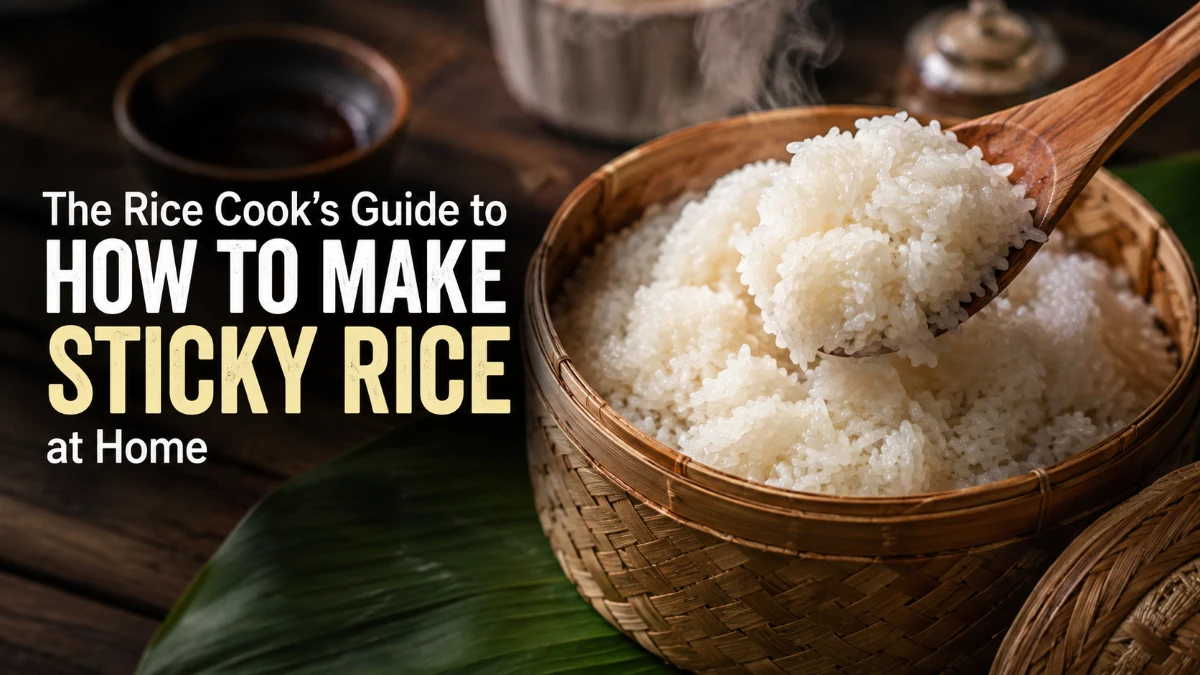
The easiest reliable way to make sticky rice is to use glutinous rice, rinse it, soak it properly, drain it well, and steam it until the grains are tender and slightly translucent. For the best texture, use a steamer; a rice cooker is the easiest hands-off option.
If you’re learning how to Make Sticky Rice, start with the rice itself. Most failures trace back to two common mistakes: using the wrong rice or rushing the soak. Fix those first, then choose the cooking method that fits your kitchen.
What You Need
Ingredients
- 1 cup glutinous, sweet, or sticky rice
- Cold water, for rinsing and soaking
- Water for steaming, kept below the rice
Equipment
Use whichever setup matches your preferred method:
- Steamer basket
- Rice cooker
- Regular pot with a fine mesh strainer
- Microwave-safe dish
Why Some Rice Sticks and Some Don’t
The stickiness of rice comes down to starch chemistry, not cooking skill. Rice grains contain two starch types — amylose and amylopectin — and glutinous rice is almost pure amylopectin, with next to no amylose. That is why it clumps into a soft, gel-like mass when cooked, while regular long-grain rice, which holds onto a meaningful share of amylose, stays fluffy and separate.
Despite the name “glutinous,” there is no actual gluten involved — the word describes a glue-like texture. Glutinous rice does not naturally contain gluten, although people avoiding gluten should still check packaging and preparation for cross-contact.
This also explains why jasmine or basmati rice cannot fully replicate true sticky rice, no matter how you cook them. They simply do not have the same starch profile. If your goal is only to make regular rice a bit clingier for something like fried rice, slightly less rinsing and a touch more water can get you partway there, but it is a different result from real glutinous rice.
How to Make Sticky Rice: The Basic Steamed Method
For the best texture, steaming is the method to start with. This is the most straightforward approach if you want tender, clingy grains without relying on an absorption-style water ratio.
1. Choose the right rice
Look for a bag labeled “glutinous rice,” “sweet rice,” or “sticky rice.” These are commonly sold by Thai or Chinese brands.
2. Rinse the rice
Rinse the rice two to three times in cold water until the water runs mostly clear. This removes excess surface starch that can make the outside gummy before the inside is cooked.
3. Soak the rice
For the most even results with steaming, soak the rice overnight or for at least 4 hours. A shorter soak of 30 minutes to a few hours can work when you are in a hurry.
4. Drain well
Drain the soaked rice thoroughly before transferring it to the steamer.
5. Set up the steamer
Line a bamboo or metal steamer basket with cheesecloth or muslin. Spread the drained rice evenly across it. Keep the water below the rice rather than letting it touch the grains.
6. Steam
Steam over boiling water for about 15–25 minutes. Larger batches or rice that had a shorter soak may need up to 30–35 minutes.
7. Check the rice
Do not rely only on the clock. The finished rice should look glossy and slightly translucent, feel tender and clingy, and have no hard or gritty center.
8. Rest before serving
Cover and rest the rice for 5–10 minutes off the heat before serving.
If you’re wondering how to Make Sticky Rice without ending up with a hard center or gummy exterior, the key is to treat the soak and steaming stages as equally important rather than trying to compensate with extra water.
How Long Should You Soak Sticky Rice?
The soak is not optional if you want the most even result. Unsoaked glutinous rice cooks unevenly because the dense starch structure needs time to absorb water before heat can gelatinize it properly.
| Soaking method | Approximate time | Best use |
| Quick soak | 30 minutes to a few hours | When you need a faster option |
| Standard soak | At least 4 hours or overnight | Best for even steaming |
| Hot-water shortcut | About 30–60 minutes | When you need to speed up softening |
A standard overnight soak is the preferred option when you have time. If you need a faster result, a hot-water soak can speed up softening, while completely skipping the soak usually produces uneven, partly hard rice.
Pick the Right Rice
Skip the guesswork at the store and look for “glutinous rice,” “sweet rice,” or “sticky rice.” It is commonly sold by Thai or Chinese brands.
If it is not available at your usual supermarket, an Asian grocery store or online source may be useful, especially for dishes such as mango sticky rice or rice balls where texture is the main point.
Steamer vs. Rice Cooker vs. Stovetop vs. Microwave
| Method | Best for | Main advantage | Main drawback |
| Steamer | Best texture | Even, traditional result | Requires steaming equipment |
| Rice cooker | Beginners | Easy and hands-off | Results can vary by machine or rice brand |
| Stovetop | No steamer | Uses basic cookware | Easier to scorch |
| Microwave | Small portions | Convenient for one or two servings | Consistency drops with larger volumes |
How to Make Sticky Rice in a Rice Cooker
A rice cooker is the easiest hands-off method, but the exact result can vary by machine and rice brand.
- Rinse the rice two to three times in cold water.
- Soak it as normal, preferably overnight or for at least 4 hours for even results.
- Drain the rice well.
- Start with about 2/3 cup of water per 1 cup of pre-soaked rice.
- Run the cooking cycle.
- When the cycle finishes, keep the lid closed and let the rice rest undisturbed for 10–15 minutes.
- Check that the grains are tender and clingy before serving.
That post-cooking rest is important. Opening the lid immediately can leave the rice crumbly rather than properly finished.
How to Make Sticky Rice Without a Steamer
If you do not own a steamer, set a fine mesh strainer inside a pot or use a careful absorption method with less water than you would use for regular rice.
For the stovetop approach, keep the rice covered over low heat. Because it can scorch more easily over direct heat, add a splash of water if it starts to look dry. Once the grains are tender, let the rice rest for 5–10 minutes.
This method can work when you do not have special equipment, but steaming remains the preferred choice for the best texture.
How to Make Sticky Rice in the Microwave
The microwave works best for one or two servings.
- Rinse, soak, and drain the rice as normal.
- Put the rice in a microwave-safe dish with a small amount of water.
- Cover and microwave in short bursts, stirring between each.
- Once the rice is tender, let it sit covered for a few minutes before serving.
This method is convenient for a small portion, but consistency drops as the volume increases.
Reading the Rice: Is It Done?
Forget the timer for a moment and check the rice itself:
- It should look glossy and slightly translucent, not chalky white.
- It should feel tender and clingy, holding together in soft clumps.
- A bite test should reveal no hard or gritty center.
- If it is still opaque and firm, give it more time.
- If it has turned wet and gluey, it has gone slightly too far.
These visual and texture checks are more useful than treating the cooking time as an absolute rule, especially when batch size and soaking time vary.
When It Goes Wrong
| What happened | Why it happened | How to fix it next time |
| Hard center | Not enough soak or cook time | Extend the soak; steam a few minutes longer |
| Mushy, gluey texture | Too much water, over-rinsing, or overcooking | Use less water; rinse more gently; check earlier |
| Uneven cooking | Rice piled too thick in the steamer | Spread thinner; stir once partway through |
| Sticking or scorching in a rice cooker | Skipped rinse, or lid opened too soon | Rinse well and let it rest undisturbed after cooking |
| Dried out, slightly yellow | Left on the warm setting too long | Unplug promptly and serve or store |
| Scorched pot bottom | Heat too high without a steamer | Lower heat; add a splash of water if it runs dry |
If the center is hard
The most likely causes are an insufficient soak or not enough cooking time. Extend the soak next time and steam the rice a few minutes longer.
If the rice is mushy
Too much water, over-rinsing, or overcooking can create a wet, gluey texture. Use less water where appropriate, rinse more gently, and check the rice earlier.
If the rice cooks unevenly
A thick layer in the steamer can cook unevenly. Spread the rice more thinly and stir it once partway through.
If the rice sticks or scorches
For a rice cooker, rinse the rice properly and avoid opening the lid too soon. For stovetop cooking, keep the heat low and add a splash of water if the rice begins to dry out.
How to Store and Reheat Sticky Rice
Sticky rice keeps for a few days in an airtight container in the fridge. To reheat, a quick re-steam or a microwave pass with a damp paper towel or a splash of water over the rice brings back most of the original softness, since cold sticky rice firms up noticeably.
Avoid leaving it on a rice cooker’s warm setting for long stretches. That is what turns it dry and slightly yellow.
Sticky Rice vs. Sushi Rice
Sushi rice is a short-grain rice that is clingier than long-grain varieties, but it still contains more amylose than true glutinous rice. The result is noticeably less sticky.
If your goal is authentic sticky rice texture, sushi rice is not a direct substitute.
Can You Use Jasmine or Basmati Rice?
They cannot fully replicate sticky rice because they contain far more amylose. Jasmine rice can be steamed softer as a rough approximation, but it will not produce the same texture as true glutinous rice.
For the closest result, start with rice specifically labeled glutinous, sweet, or sticky rice.
What Makes Sticky Rice Sticky?
It is the starch balance. Glutinous rice is almost entirely amylopectin with very little amylose, and amylopectin is what causes the grains to clump together when cooked.
That is also why simply changing the amount of water used with ordinary long-grain rice cannot fully reproduce the texture of true glutinous rice.
Where This Rice Actually Shows Up
Once you have the technique down, sticky rice opens the door to a lot of dishes: grilled meats and papaya salad in Lao and Thai cooking, mango sticky rice for dessert, rice balls, and various dim sum preparations in Chinese cuisine.
The base method here is the same regardless of where the rice ends up on your plate.
Read more: How Many Calories Should I Eat a Day?
Frequently Asked Questions
It is the starch balance — glutinous rice is almost entirely amylopectin with very little amylose, and amylopectin is what causes grains to clump together when cooked.
Glutinous rice does not naturally contain gluten. “Glutinous” refers to the glue-like texture, not gluten content. If you need to avoid gluten, check packaging and preparation for cross-contact.
You can shorten it with a hot-water soak of around 30–60 minutes, but skipping it entirely usually leads to uneven, partly hard rice.
It likely needs the post-cooking rest period. Leave it covered and undisturbed for 10–15 minutes after the cycle ends before fluffing.
Sushi rice is a short-grain rice that is clingier than long-grain varieties, but it still contains meaningfully more amylose than true glutinous rice, so it is noticeably less sticky.
They will never fully replicate sticky rice’s texture since they contain far more amylose, though jasmine can be steamed softer as a rough approximation.
Start with around 2/3 cup of water per cup of pre-soaked rice, then adjust slightly based on how your specific cooker and rice brand behave.
Almost always too much water, over-rinsing, or letting it cook a bit too long. Ease back on water and check doneness earlier next time.
Yes. A fine mesh strainer set inside a regular pot or a careful low-water absorption method can work as a steamer substitute.
A few days in an airtight container in the fridge. Reheat it with a splash of water and a quick microwave pass or re-steam.