
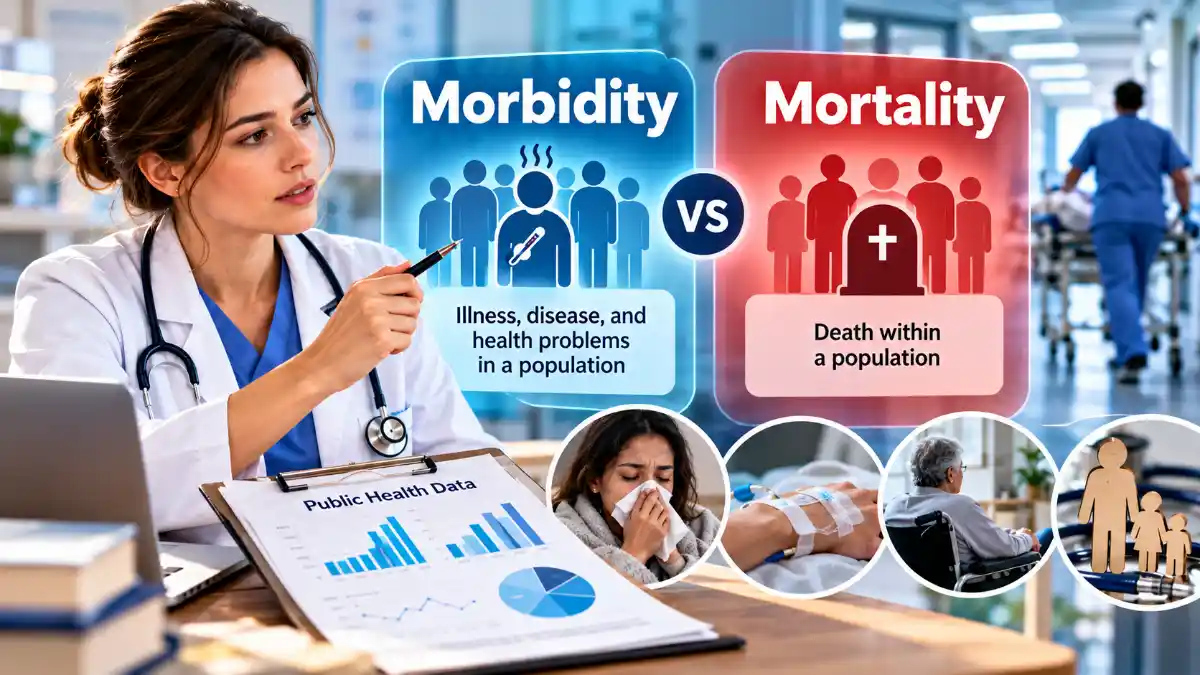
Morbidity (pronounced mor-BIH-dih-tee) means having a disease, illness, or another health problem. In medicine, it can describe a person’s health condition or the amount of illness affecting a population. Morbidity includes diseases, injuries, disabilities, and complications caused by medical treatment. For example, someone living with diabetes experiences morbidity because they have a chronic condition, even if it never causes their death.
In public health, morbidity helps researchers understand how often people become ill and how those illnesses affect communities. Unlike mortality, which refers to death, morbidity focuses on health problems people experience while living. Healthcare professionals use this information to track diseases, recognize health trends, and identify communities that may need additional medical resources.
What Does Morbidity Mean in Medical Terms?
The medical meaning of morbidity covers both an individual’s experience of illness and the occurrence of disease across a population. It does not necessarily mean someone is seriously ill or has a life-threatening condition.
For example, a person might experience morbidity from a respiratory infection, a long-term condition such as diabetes, or a disability that makes everyday activities more difficult. Complications following surgery or another medical procedure can also count as morbidity.
At the population level, researchers look at how many people develop an illness, how many currently have it, and what effects the condition may have on their health. The National Cancer Institute’s definition of morbidity recognizes these individual, population, and treatment-related meanings.
One important distinction is that morbidity does not tell us how severe an illness is. A mild infection and a disabling chronic disease both contribute to morbidity, but they can affect a person’s life in very different ways.
Morbidity vs. Mortality: What’s the Difference?
The main difference between morbidity and mortality is straightforward: morbidity describes illness and health problems, while mortality describes death.
| Comparison | Morbidity | Mortality |
| Definition | Having or experiencing illness or health problems | Death within a population |
| What it measures | Illness occurrence and related health effects, depending on the indicator | Frequency or risk of death |
| Common measurements | Incidence, prevalence, hospitalization rates | Death rates, cause-specific mortality rates |
| Example | People living with diabetes | Deaths attributed to diabetes |
| Practical meaning | Helps explain how illness affects people | Helps explain fatal outcomes |
A disease can cause considerable morbidity without having a high mortality rate. Consider a widespread respiratory infection that makes many people sick enough to miss work or school, even though relatively few affected individuals die.
Chronic conditions offer another example. Someone may live with an illness for decades, require regular medical care, and experience limitations in daily activities without dying directly from that condition.
This is why researchers consider both measurements. Death statistics alone cannot capture how much illness a community experiences or how those health problems affect people’s lives.
How Is Morbidity Measured?
In epidemiology, two commonly used morbidity measurements are incidence and prevalence. Although they are closely related, they answer different questions.
Incidence and Prevalence
Incidence refers to new cases of a disease that develop within a particular population over a specified period.
Prevalence describes the proportion of people who have a condition at a specific point in time or during a defined period. It includes people who developed the disease recently and those who already had it.
Consider these hypothetical examples:
- Incidence: Of 1,000 people who initially do not have a respiratory infection, 50 develop it over one year. The one-year incidence proportion is 5%.
- Prevalence: In a separate community of 1,000 people, 100 have diabetes on a particular date. The point prevalence is 10%.
The first example shows how frequently new cases develop. The second shows how common an existing condition is at one moment.
Both measurements are useful, but they should not be confused. The CDC’s epidemiology guidance on morbidity frequency measures explains these distinctions and how researchers calculate them.
What Is a Morbidity Rate?
A morbidity rate generally describes how frequently illness occurs within a defined population. However, the expression is sometimes used broadly for different measurements, including incidence proportions, person-time incidence rates, and prevalence.
These indicators are related, but they are not interchangeable.
For example, researchers can calculate an incidence proportion using this formula:
Incidence proportion = (New cases during a specified period ÷ Population initially at risk) × 100
Using the earlier respiratory infection example, 50 new cases among 1,000 initially disease-free people produce a one-year incidence proportion of 5%.
An incidence rate works differently because it accounts for the total amount of time people spend under observation while at risk of developing the condition.
Suppose researchers observe 20 new cases during 2,000 person-years of follow-up. The incidence rate would be 10 cases per 1,000 person-years.
Other morbidity indicators may focus on hospital admissions, complications, or particular diseases. Each requires a clearly defined population, denominator, and observation period.
When reading a medical report, checking exactly what the measurement counts are is essential. A percentage describing people who already have a disease tells a different story from a rate describing new cases over time.
Examples of Morbidity in Healthcare
Morbidity is relevant across many areas of medicine, from everyday infections to serious complications.
Chronic diseases: Conditions such as diabetes contribute to long-term morbidity because they may require ongoing medical attention and affect daily activities.
Respiratory infections: Influenza and other respiratory illnesses contribute to morbidity through symptoms, complications, and, in some cases, hospitalization.
Medical procedures: Postoperative infections, surgical complications, and certain unwanted treatment effects are examples of treatment-related morbidity.
Maternal health: Severe maternal morbidity involves unexpected complications of labor and delivery that can have serious short- or long-term health consequences. These complications may require intensive medical care. The CDC provides a specific framework for identifying severe maternal morbidity, particularly when studying childbirth-related hospitalizations.
Comorbidity: This related term describes having two or more diseases or health conditions at the same time. For example, someone with diabetes who also has hypertension has coexisting conditions.
Although the terms sound similar, they have different meanings. Morbidity refers broadly to illness or health problems, while comorbidity refers specifically to conditions occurring together.
Why Is Morbidity Important in Public Health?
Understanding morbidity in epidemiology helps healthcare professionals recognize disease patterns, monitor population health, and make informed decisions about medical services.
In the United States, morbidity data plays an important role in disease surveillance, healthcare research, and public health planning. The Centers for Disease Control and Prevention (CDC) publishes the Morbidity and Mortality Weekly Report (MMWR), which shares findings about diseases, outbreaks, surveillance, and other public health concerns.
Researchers also use morbidity information to investigate why some communities experience more illness than others. Disease exposure, existing health conditions, environmental circumstances, and access to healthcare may all influence the patterns they observe.
Still, an increase in reported morbidity does not automatically mean a disease has become more dangerous. Better diagnosis, expanded screening, or changes in reporting practices can also affect the numbers.
Likewise, high morbidity does not necessarily mean high mortality. The interpretation depends on the health condition, the population being studied, and the measurement used.
Looking at morbidity alongside mortality and other health indicators gives public health professionals a fuller picture of a community’s health needs.
Read Also: Morbidity
Frequently Asked Questions
What Causes High Morbidity in a Population?
High morbidity can result from widespread infectious diseases, chronic health conditions, injuries, environmental exposures, and limited access to healthcare. However, higher reported morbidity may also reflect improved testing, increased screening, or more complete disease reporting rather than an actual rise in illness.
What Is the Difference Between Morbidity and Comorbidity?
Morbidity refers to having an illness or health problem, while comorbidity means having two or more medical conditions at the same time. For example, a person with diabetes experiences morbidity. If that person also has high blood pressure, the additional condition is considered a comorbidity.
Can a Disease Have High Morbidity but Low Mortality?
Yes. A disease can affect many people or cause significant health problems without resulting in many deaths. For example, some respiratory infections cause widespread illness, missed workdays, and medical visits but relatively few deaths. This illustrates why morbidity and mortality are measured separately when evaluating the impact of a disease.