
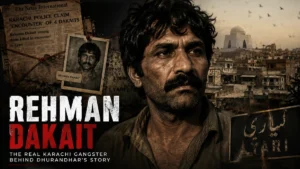
Rehman dakait, born Sardar Abdul Rehman Baloch, was a Karachi crime boss from the Lyari neighbourhood who built a criminal and political network before dying in a disputed police encounter on 9 August 2009. His story resurfaced widely in late 2025 because the film Dhurandhar dramatizes his life, though several of the movie’s biggest claims about him diverge sharply from the documented record
Early Life in Lyari
Sources place his birth year inconsistently between 1975 and 1980, so this detail should be treated as approximate rather than settled. He was born in Lyari, one of Karachi’s oldest and poorest neighbourhoods, where his father, known locally as “Dadal,” was already involved in the local drug trade
Rehman dakait entered Lyari’s underworld as a teenager and became attached to the Haji Laloo gang. In 1995, according to Sindh Police records, he killed his own mother; the exact motive remains disputed and is partly rumour-based, so it should not be presented as fully settled
Rise Through the Lyari Gang War
Rehman dakait escaped police custody in 1997 and used the years that followed to expand from drug peddling into extortion, contract killing, and kidnapping. When the Haji Laloo gang splintered after Laloo’s 2001 arrest, it broke into two rival factions: Rehman’s Baloch-dominated gang and Arshad Pappu’s Pathan-led faction, setting up the feud that came to define the Lyari gang war
This rivalry drove years of violence across Lyari and neighbouring areas, and Rehman dakait used the fighting to extend his influence into Malir and Korangi, competing directly with other Karachi crime networks
Political Patronage and the People’s Aman Committee
Around 2008, Rehman dakait rebranded himself as “Sardar Abdul Rehman Baloch” and formed the Peoples Aman Committee, presenting it as a peacekeeping body for Lyari. The committee developed close, if officially denied, ties to the ruling Pakistan Peoples Party, giving him real influence in Karachi’s local politics even as the group continued extortion and territorial enforcement
Arrest, Escape, and the 2009 Encounter
Police arrested Rehman dakait in Quetta in November 2008, but he escaped custody again shortly after. On 9 August 2009, a police team led by SSP Chaudhry Aslam Khan intercepted him and three associates near Karachi’s Steel Town area; a shootout followed, and all four men died
The circumstances remain disputed. His death has been widely described as an alleged fake police encounter rather than a genuine shootout, and it sparked riots across parts of Karachi at the time. Politician Zulfiqar Mirza separately claimed personal responsibility for having Rehman dakait “taken out,” though he later reframed this as having ordered the arrest operation during which the encounter occurred — a claim that should be treated as a political statement, not established fact
Aftermath and Family Legacy
After his death, leadership of the People’s Aman Committee passed to his cousin Uzair Baloch, who expanded its power until his own arrest in 2015. In Lyari, Rehman dakait is remembered by many locals less as a criminal than as a benefactor who redistributed money to the poor; his supporters treated him as a martyr, even as authorities and much of the outside world viewed him purely as a criminal
His sons have not escaped that legacy. Sarban Baloch, his eldest son and successor, was killed on 11 March 2024 near Jubilee Market in Karachi’s Old City area during what police described as an exchange of fire but rights observers called a contested “encounter,” echoing his father’s own disputed death. A younger son, Jibran Baloch, was arrested again in Karachi in February 2026 after police recovered an illegal pistol, with authorities describing him as a repeat offender
Fact-Checking Dhurandhar’s 26/11 Claim
Dhurandhar casts Rehman dakait as a figure who allegedly helped provide “safe passage” for the 2008 Mumbai attackers, but this claim has no support in the primary investigative record. His name does not appear anywhere in Mumbai Police’s roughly 11,000-page charge sheet or the evidence shared with the FBI, and the attacks are officially attributed to Lashkar-e-Taiba planners such as Zakiur Rehman Lakhvi, not Karachi gangland figures.
Journalists and regional analysts who have examined the film’s claims separately describe the 26/11 link as a dramatic invention layered onto a real person’s name, blending the terrorist Zakiur “Rehman” Lakhvi with the gangster “Dakait” to create a composite villain. What the film gets closer to reality on is Rehman dakait’s rise in Lyari, his rivalry with Arshad Pappu, and his death at the hands of Chaudhry Aslam — the terrorism connection is the part built for cinema, not for the historical record
FAQs
Who was Rehman dakait?
Rehman dakait, born Sardar Abdul Rehman Baloch, was a Karachi gangster from the Lyari neighbourhood who led a major criminal network and formed the Peoples Aman Committee, a group with ties to the Pakistan Peoples Party.[
How did Rehman dakait die?
He was killed on 9 August 2009 in a police encounter in Karachi’s Steel Town, led by SSP Chaudhry Aslam Khan; his death has been widely alleged to be a staged or extrajudicial killing rather than a genuine shootout
Was Rehman dakait really connected to the 26/11 Mumbai attacks?
No verified evidence supports this. His name is absent from Mumbai Police’s charge sheet and the evidence shared with the FBI, and the attacks are attributed to Lashkar-e-Taiba planners, not Lyari gangsters.
What was the People’s Aman Committee?
It was an organization Rehman dakait founded around 2008, presented as a community peacekeeping body in Lyari but linked to extortion and enforcement, with unofficial ties to the Pakistan Peoples Party.
Who took over after Rehman dakait’s death?
His cousin Uzair Baloch led the Peoples Aman Committee after 2009 until his own arrest in 2015; his eldest son Sarban Baloch briefly emerged as a successor before being killed in 2024
Is the movie Dhurandhar an accurate portrayal of Rehman dakait?
Only partially. The film’s depiction of his Lyari rise, his rivalry with Arshad Pappu, and his death by police encounter aligns broadly with the historical record, but the 26/11 terrorism link is considered a fictional addition
What happened to Rehman dakait’s family after his death?
His eldest son, Sarban Baloch, was killed in a contested 2024 police encounter, and another son, Jibran Baloch, was arrested on weapons charges in 2026, showing the family’s continued entanglement with Lyari’s underworld