
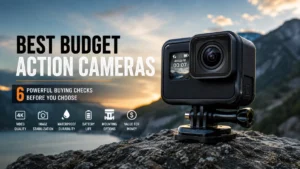
The Best Budget Action Cameras are the ones that still work for your intended activity after you factor in stabilization settings, waterproof conditions, storage, mounting, and power. A low sticker price is useful only if the camera can capture the footage you want without forcing expensive compromises later.
Start by deciding what can go wrong in your footage. For cycling, it is an unstable video. For water use, it is relying on the wrong waterproof rating. For travel, it may be a dead battery, a full memory card, or a camera that is too awkward to use quickly.
Start with the failure point
A budget action camera does not need to do everything. It needs to avoid failing at the task you bought it for.
| Main activity | The failure point to avoid | What to check first |
| Travel and holidays | Missing quick moments because the camera is awkward to operate | Controls, size, basic 4K mode, storage workflow |
| Cycling or motorcycling | Footage spoiled by movement and an unsuitable mount | Stabilization availability in your recording mode, mount compatibility |
| Swimming and snorkelling | Water entering a camera or using the wrong depth rating | Bare-camera depth, housing requirement, seals and lens guard |
| Beginner vlogging | Poor framing or inconvenient transfer/editing workflow | Screen, compactness, app workflow, audio plan |
| Slow-motion clips | Discovering that high frame rates are limited to lower resolutions | Exact resolution and frame-rate combinations |
This is the most useful way to compare the Best Budget Action Cameras. Product pages can list 4K, waterproofing, and stabilization together, but the details determine whether those features work simultaneously in the mode you need.
Stabilization is a settings question
For moving footage, do not simply look for “EIS” or “stabilization” on a sales page. Check the manual or technical specifications for the precise resolution, frame rate, field of view, and mode where it is available.
DJI’s Osmo Action 4 shows why this matters. It supports 4K recording up to 120fps, but DJI states that stabilization is unavailable in slow-motion and time-lapse modes. Its 155-degree field-of-view mode also requires stabilization to be turned off and is available up to 4K at 60fps.
That does not make the camera less capable; it clarifies the buying decision. If smooth cycling footage is the priority, choose the settings that preserve stabilization. If slow motion or the widest field of view matters more, accept the mode-specific trade-off.
Waterproof claims need translation
A camera may be waterproof on its own, protected only from splashes, or ready for deeper water only when fitted in a dedicated case. Those are different levels of protection.
The DJI Osmo Action 4 is listed as waterproof to 18m without a case. DJI recommends its waterproof case for extended underwater recording and high-impact water conditions. SJCAM lists the SJ30 as waterproof to 5m without its case and up to 30m with its case.
Insta360’s GO 3S demonstrates another important condition: the camera is waterproof to 10m only with its lens guard installed, while the Action Pod is splash-resistant and should not be submerged. A Dive Case takes the camera-and-pod combination to a stated depth of 60m.
For the Best Budget Action Cameras used around water, read the small print as carefully as the depth number. Confirm what is submerged, what must be installed, and whether the activity involves prolonged underwater use, impact from waves, or water sport speeds.
The shortlist: buy for the job
Simple daylight recording: SJCAM SJ4000 Air
The SJCAM SJ4000 Air is an entry-level route for occasional travel clips and basic first-person footage. Its official product page lists 4K at 30fps, 1080p at up to 60fps, 720p at up to 120fps, Wi-Fi control, a 2-inch display, a 170-degree field of view, and a waterproof case rated to 30m.
The published specification does not list stabilization. That makes it a less appropriate fit for buyers who specifically need documented stabilization for riding or other movement-heavy video. It is better approached as a straightforward daylight camera than as a low-cost substitute for a feature-rich sport camera.
Compact branded system: GoPro HERO
GoPro HERO suits buyers who want a small camera, uncomplicated recording modes, and access to GoPro’s established mount ecosystem. GoPro lists 4K video at 30 or 25fps, 2.7K at 60fps, 12-megapixel photos, 16-foot waterproofing, and a built-in Enduro battery.
GoPro also says that HyperSmooth stabilization is automatically applied through the Quik app. That can suit a simple phone-led editing workflow, but it is a different proposition from in-camera stabilization being available while you record. Check that workflow before treating it as the right option for sustained action footage.
Tiny hands-free clips: Insta360 GO 3S
The Insta360 GO 3S is a specialist option for hands-free, compact point-of-view shots rather than a conventional rugged action-camera replacement. Insta360 lists 4K video at up to 30fps and a 10m waterproof rating for the camera when its lens guard is fitted.
Its small, magnetic camera design can make it useful for lightweight travel angles and creative POV placement. But the Action Pod is only IPX4 splash-resistant, so it should not be treated as an underwater unit without the Dive Case.
Longer sessions and flexible framing: SJCAM SJ30
The SJCAM SJ30 lists 4K video at up to 60fps, a flip screen, 5m body waterproofing, and microSD-card support up to 512GB. It also has a 2,000mAh built-in battery and a 30m waterproof-case rating.
This option is most relevant when front-facing framing and longer-session planning matter. Manufacturer runtime figures are condition-specific, so regard them as a starting estimate rather than a guarantee for every temperature, recording mode, or battery condition.
Discounted step-up for demanding capture: DJI Osmo Action 4
The DJI Osmo Action 4 becomes a budget contender only when a credible sale, clearance offer, or trusted refurbished package places its total cost within your target range. Its official specifications include a 1/1.3-inch sensor, 4K recording up to 120fps, a 155-degree field of view, and waterproofing to 18m without a case.
For buyers comparing Best Budget Action Cameras for outdoor action, it is a conditional upgrade path rather than an automatic recommendation. Its expanded capture options matter only if you will use them, and mode restrictions still apply.
Build the real budget
The camera body price is only the first figure. Build a realistic total before choosing:
- A compatible microSD card from a reputable brand
- A mount designed for your activity, such as a handlebar, helmet, chest, or adhesive mount
- A power plan, including charging access and spare capacity where possible
- A waterproof housing or protective case if the activity goes beyond the camera’s bare-camera rating
- A return route that gives you a practical option if the product does not suit your workflow
The Best Budget Action Cameras are often the cameras with the lower total cost of getting usable footage—not simply the lowest initial price.
Choose your recording mode first
Before you buy, write down one realistic filming setting. For example:
“I need stable 4K footage for weekend cycling rides.”
Then verify that the candidate camera can record that setting with the stabilization you need, using an appropriate mount and a compatible memory card. This approach is more reliable than comparing a long list of isolated specifications.
If your actual requirement is “slow-motion clips of football practice,” the decision changes. You may prefer a camera that offers high frame rates at the resolution you plan to edit, even if it cannot stabilize that exact mode.
Before checkout
- Confirm the exact resolution, frame rate, and field of view you expect to use.
- Verify whether stabilization is available in that exact mode.
- Identify whether waterproofing applies to the camera alone, a lens guard, or a housing.
- Add memory, mounting, power, and water-protection costs to the camera price.
- Check the model generation and included accessories, especially for clearance and refurbished listings.
- Review the manufacturer’s memory card, accessory, and care guidance.
- Choose a seller with a transparent return option for unfamiliar brands or marketplace listings.
Frequently Asked Questions
Prioritise the feature most connected to your use: mode-specific stabilization for riding, waterproof setup for water use, or simple controls and storage for travel.
They can be, but 4K is only one part of the result. Check frame rate, stabilization availability, battery needs, storage, and the footage conditions you expect.
The camera is rated to 10m when its lens guard is installed. The Action Pod is splash-resistant and should not be submerged unless used with the appropriate Dive Case.
It can record 4K video, but buyers should understand that its HyperSmooth stabilization is applied through the Quik app. Confirm that this post-capture workflow fits the type of cycling footage you want.
Choose based on the exact activity and depth. Compare the bare-camera depth rating, required lens guards or housings, and whether the manufacturer advises a case for extended underwater use.
You need a compatible, dependable microSD card that meets the camera maker’s requirements. Check the manual before you buy, especially if you plan to record high-resolution or high-frame-rate video.