
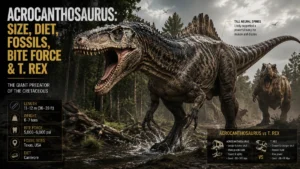
Acrocanthosaurus was one of the largest predatory dinosaurs of the Early Cretaceous and one of the most distinctive giant theropods ever discovered in North America. It is best known for the unusually tall neural spines projecting upward from many vertebrae along its neck, back, hips, and tail. Those remarkable structures inspired the name Acrocanthosaurus, meaning “high-spined lizard.”
The dinosaur belonged to Carcharodontosauridae, a group of large allosauroid theropods that also included famous predators such as Giganotosaurus and Carcharodontosaurus. Unlike Tyrannosaurus rex, which lived much later, Acrocanthosaurus was an Early Cretaceous predator that occupied North American ecosystems tens of millions of years before T. rex appeared.
The most complete known skeleton, NCSM 14345, commonly called “Fran,” has provided much of what scientists know about Acrocanthosaurus anatomy, body proportions, skull structure, forelimbs, and overall size. More recent research has also expanded our understanding of its geographic distribution, including a significant 2024 fossil discovery in Maryland.
Acrocanthosaurus Quick Facts
| Fact | Details |
| Scientific name | Acrocanthosaurus atokensis |
| Name meaning | “High-spined lizard” |
| Geological age | Early Cretaceous |
| Best-known time interval | Aptian–Albian Early Cretaceous |
| Known length | About 11–11.5 m (36–38 ft) for the most complete large specimen |
| Body mass | Estimates vary substantially by specimen and reconstruction method |
| Diet | Carnivorous |
| Classification | Carcharodontosaurid allosauroid theropod |
| Best-known specimen | NCSM 14345, “Fran” |
| Main fossil regions | Oklahoma, Texas, Wyoming, and Maryland |
| Most distinctive feature | Exceptionally tall neural spines along the vertebral column |
What Was Acrocanthosaurus?
Acrocanthosaurus was a giant, bipedal theropod that lived during the Early Cretaceous in what is now North America. It was a large terrestrial predator with a long tail, powerful hind limbs, a substantial skull, functional forelimbs, and a highly unusual series of elongated neural spines along the vertebrae.
The genus is particularly important to paleontology because its fossils preserve a combination of size, anatomy, and geographic information, making it one of the best-known giant predatory dinosaurs of its time.
Although Acrocanthosaurus is sometimes casually described as an “early T. rex,” that comparison can be misleading. The two dinosaurs were separated by tens of millions of years and belonged to different evolutionary lineages. Acrocanthosaurus was an allosauroid carcharodontosaurid, whereas T. rex was a tyrannosaurid coelurosaur.
How Big Was Acrocanthosaurus?
Acrocanthosaurus was an enormous theropod. The most complete and best-studied large specimen, NCSM 14345, was reconstructed at approximately 11.5 meters (38 feet) long.
That places Acrocanthosaurus among the largest known theropods of the Early Cretaceous. Its overall proportions included a huge skull, long muscular tail, powerful hind limbs, and relatively large forelimbs.
How Long Was Acrocanthosaurus?
The commonly cited length for the best-known large specimen is approximately:
11–11.5 meters (36–38 feet).
The exact figure depends on how the skeleton is reconstructed and which specimen is being considered. Fragmentary fossils do not necessarily represent animals of the same age or body build, so one length should not automatically be applied to every Acrocanthosaurus individual.
How Much Did Acrocanthosaurus Weigh?
Body mass is much harder to estimate than length because soft tissues, organs, muscles, and body volume are not preserved in the fossil record.
Earlier reconstructions produced estimates in the range of several metric tonnes, including values around 4.4–6.6 tonnes for some reconstructions of the large NCSM 14345 specimen.
However, newer volumetric modeling has shown why a single weight number should be treated cautiously. A 2025 study by Dempsey and colleagues used skeletal-to-soft-tissue scaling methods and produced an average modeled body mass for Acrocanthosaurus close to 9 tonnes. The authors also noted that different estimation methods can produce substantially different results.
The safest conclusion is therefore that Acrocanthosaurus was a multi-ton giant predator, but its exact body mass remains model-dependent.
This is an important distinction: length can be measured directly from bones, while mass must be reconstructed from assumptions about the animal’s soft-tissue envelope, body shape, posture, and tissue density.
How Tall Was Acrocanthosaurus?
A precise standing height is more difficult to establish than total length because it depends on posture and skeletal reconstruction.
Rather than assigning one definitive height, it is more scientifically useful to describe Acrocanthosaurus as a very large, long-bodied bipedal theropod with massive hind limbs and a skull exceeding a meter in length in the largest known individuals.
The height of its neural spines also makes the animal appear particularly tall through the back, but those spines should not be confused with total body height.
What Did Acrocanthosaurus Look Like?
Acrocanthosaurus had the general body plan of a giant predatory theropod:
- A large, elongated skull
- Strong jaws lined with serrated teeth
- Powerful hind limbs
- Large forelimbs
- A long, muscular tail
- A bipedal posture
- Exceptionally tall neural spines along the vertebral column
Its most recognizable feature was the row of elongated neural spines projecting upward from many of the vertebrae.
These spines were especially prominent across the neck, back, hips, and portions of the tail. They are the anatomical features most directly responsible for the genus name “high-spined lizard.”
The fossil evidence establishes the presence and unusual length of these structures, but it does not establish a single certain reconstruction of the animal’s external appearance.
Acrocanthosaurus Anatomy
Acrocanthosaurus anatomy is one of the main reasons the genus is so important to dinosaur research.
| Anatomical feature | What it tells us |
| Skull | A large predatory skull adapted for processing substantial prey |
| Teeth | Serrated teeth consistent with a carnivorous diet |
| Neural spines | Exceptionally elongated vertebral projections |
| Forelimbs | Functional but not used as weight-bearing limbs |
| Hind limbs | Powerful structures supporting a very large bipedal body |
| Tail | Long structure involved in balance and locomotor mechanics |
| Vertebral column | Highly distinctive because of the elongated neural spines |
| Overall body plan | Giant allosauroid theropod |
The most complete specimen, NCSM 14345, preserved extensive information about the skull, forelimb, vertebral column, and other parts of the skeleton. This has allowed researchers to make much more informed interpretations than would be possible from isolated bones alone.
Why Did Acrocanthosaurus Have Such Tall Spines?
The tall neural spines are the defining anatomical characteristic of Acrocanthosaurus, but their exact function remains uncertain.
Possible explanations have included:
- Supporting substantial soft tissues
- Providing enlarged surfaces for muscle attachment
- Contributing to body shape or display structures
- Performing more than one function
The bones themselves provide strong evidence that the structures were unusually elongated. They do not, however, preserve enough soft tissue to prove exactly what the animal’s back looked like.
For that reason, the most defensible scientific explanation is that the spines were an important part of Acrocanthosaurus anatomy, while their precise external appearance and biological function remain subjects of interpretation.
How Strong Was the Bite of Acrocanthosaurus?
A 2022 study by Manabu Sakamoto estimated Acrocanthosaurus bite force using a phylogenetically informed biomechanical model.
The study estimated:
| Bite location | Estimated force |
| Anterior bite force | 8,266 N |
| Posterior bite force | 16,984 N |
These are model-based estimates, not direct measurements from a living animal.
The difference between the front and back of the jaws is also important. Bite force increases toward the rear of the jaw, where the mechanical leverage is more favorable.
The study demonstrates that body size alone does not determine bite force. Skull architecture, jaw proportions, muscle arrangement, and biomechanical leverage all affect feeding performance.
Acrocanthosaurus vs Tyrannosaurus rex
Acrocanthosaurus and Tyrannosaurus rex are frequently compared because both were enormous North American theropods.
However, they were separated by tens of millions of years and belonged to completely different evolutionary branches.
| Trait | Acrocanthosaurus | Tyrannosaurus rex |
| Time period | Early Cretaceous | Late Cretaceous |
| Common length estimate | About 11–11.5 m | Up to roughly 12–12.4 m in the largest specimens |
| Body mass | Highly variable estimates, newer volumetric modeling can approach 9 tonnes | Generally reconstructed as heavier in the largest specimens |
| Family | Carcharodontosauridae | Tyrannosauridae |
| Broader group | Allosauroidea | Coelurosauria |
| Defining feature | Extremely tall neural spines | Deep, robust skull and enormous bite |
| Estimated anterior bite force | 8,266 N | Much higher in biomechanical models |
| Estimated posterior bite force | 16,984 N | Much higher in biomechanical models |
The comparison should not be reduced to a simple question of which dinosaur was “stronger.”
Acrocanthosaurus had a different skull, different evolutionary history, different body proportions, and different ecological context. It also evolved many millions of years before T. rex.
Was Acrocanthosaurus Bigger Than T. rex?
Based on commonly cited reconstructions, the largest Tyrannosaurus rex specimens were generally longer and heavier than the best-known Acrocanthosaurus specimens.
Acrocanthosaurus reached approximately 11–11.5 meters in the most complete large skeleton, while the largest T. rex specimens can reach roughly 12–12.4 meters.
Mass comparisons are more complicated because reconstructed body weight varies substantially depending on methodology.
The important point is that Acrocanthosaurus was already a giant predator long before T. rex evolved.
Did Acrocanthosaurus Have a Stronger Bite Than T. rex?
No. Available biomechanical models indicate that T. rex had a substantially stronger bite.
The 2022 modeling work estimated Acrocanthosaurus at approximately 8,266 N at the front of the jaws and 16,984 N toward the rear.
The modeled T. rex bite forces were substantially higher.
These numbers should still be interpreted as biomechanical estimates rather than direct measurements. Fossilized jaws cannot provide a literal reading of the force produced by extinct muscles.
How Did Acrocanthosaurus Hunt?
Acrocanthosaurus was a large terrestrial carnivore that lived alongside substantial herbivorous dinosaurs.
Its anatomy indicates that the head and jaws played a major role in feeding. Its forelimbs were not built as weight-bearing limbs, and studies of their range of motion suggest they were relatively restricted compared with some other large theropods.
This supports the interpretation that the skull and jaws were central to prey capture and feeding.
Exactly how Acrocanthosaurus attacked large prey is much harder to establish. Fossils can reveal anatomy and mechanical potential, but they rarely preserve enough direct evidence to reconstruct one specific hunting sequence with certainty.
What Did Acrocanthosaurus Eat?
Acrocanthosaurus was a carnivore and probably preyed on large herbivorous dinosaurs that shared its Early Cretaceous ecosystems.
Potential prey included large sauropods and ornithopods such as:
- Sauroposeidon
- Tenontosaurus
These animals were part of ecosystems in which giant theropods had access to substantial sources of animal protein.
Acrocanthosaurus had a large skull, powerful jaw musculature, and serrated teeth capable of processing significant amounts of tissue.
However, the presence of large herbivores in the same environment does not prove that Acrocanthosaurus regularly hunted every one of them. Fossil evidence rarely allows researchers to assign a specific prey species with certainty.
Did Acrocanthosaurus Hunt in Packs?
There is no confirmed evidence that Acrocanthosaurus routinely hunted in coordinated packs.
Large theropod trackways from Texas have sometimes been discussed in connection with group movement. However, multiple tracks traveling in the same general direction do not automatically demonstrate cooperative hunting.
The animals could have moved through the same area independently, followed similar terrain, or used the same environmental route at different times.
The most responsible conclusion is that possible group behavior remains an open question rather than an established fact.
How Fast Was Acrocanthosaurus?
There is no single universally accepted maximum speed for Acrocanthosaurus.
Researchers can use limb proportions, biomechanics, trackways, computer models, and assumptions about muscle performance to investigate dinosaur locomotion. However, the resulting estimates can change depending on body mass, posture, gait, and the mechanical assumptions used.
For that reason, it is better to describe Acrocanthosaurus as a large bipedal predator adapted for terrestrial movement than to present one precise speed as a proven fact.
When and Where Was Acrocanthosaurus Discovered?
The first Acrocanthosaurus fossils were discovered in 1950 in Atoka County, Oklahoma, by paleontologists J. Willis Stovall and Wann Langston Jr.
The species name atokensis refers to Atoka County, linking the animal’s scientific identity directly to its initial discovery locality.
The genus is associated primarily with Early Cretaceous rocks of North America. Important material has been documented from:
- Oklahoma
- Texas
- Wyoming
- Maryland
The Maryland evidence is particularly significant because it expanded the well-supported geographic range of Acrocanthosaurus into eastern North America.
The Famous “Fran” Acrocanthosaurus Specimen
NCSM 14345, commonly known as “Fran,” is the most famous and one of the most complete Acrocanthosaurus specimens.
Its importance comes from the exceptional amount of anatomical information it preserves.
The specimen includes a complete skull and extensive portions of the rest of the skeleton, allowing researchers to study:
- Skull anatomy
- Forelimb structure
- Vertebral anatomy
- Body proportions
- Locomotor mechanics
- Feeding biomechanics
- Overall body size
Because so much of the skeleton is preserved, “Fran” is an essential reference for many modern discussions of Acrocanthosaurus.
The specimen is housed in the vertebrate paleontology collection of the North Carolina Museum of Natural Sciences.
New Acrocanthosaurus Fossil Discovery in Maryland
One of the most important recent developments in Acrocanthosaurus research came from Maryland.
In 2024, paleontologist Matthew T. Carrano published a study describing an associated partial theropod skeleton, USNM 466054, from the Lower Cretaceous Arundel Clay.
The specimen contains anatomical features supporting its identification as Acrocanthosaurus and represents the strongest evidence yet for the genus in eastern North America.
The discovery is important for two reasons.
First, it strengthens the evidence that Acrocanthosaurus was geographically widespread across North America during the Early Cretaceous.
Second, the Maryland specimen was interpreted as a young individual and expands the known range of body sizes represented in the fossil record.
Carrano’s 2024 study also emphasized an important scientific limitation: although Acrocanthosaurus appears to have ranged widely across North America, it remains uncertain whether all fossil material currently assigned to the genus belongs to the same species.
Where Did Acrocanthosaurus Live?
Acrocanthosaurus inhabited parts of North America during the Early Cretaceous.
Fossil evidence connects the genus with regions that are now:
- Oklahoma
- Texas
- Wyoming
- Maryland
The animal lived in ecosystems containing large herbivorous dinosaurs, other reptiles, and smaller theropods.
As one of the largest terrestrial carnivores in these environments, Acrocanthosaurus likely occupied an apex or near-apex predatory role.
The exact appearance of its habitat is reconstructed from geology, associated fossils, and sedimentary evidence because no complete ancient ecosystem has been preserved intact.
Acrocanthosaurus Fossils and the Fossil Record
The fossil record of Acrocanthosaurus has become increasingly important as new specimens and interpretations have expanded the known geographic range of the genus.
Key evidence includes:
- The original Oklahoma discoveries
- Large theropod material from Texas
- Fossils from Wyoming
- The nearly complete NCSM 14345 specimen
- The 2024 Maryland partial skeleton
Each specimen contributes something different.
The most complete skeletons provide information about anatomy and proportions, while more fragmentary discoveries can reveal geographic distribution, growth, or the presence of the genus in new geological settings.
This is why a dinosaur’s fossil record should not be judged solely by how complete its most famous skeleton is.
Growth and Development
Acrocanthosaurus was not born at full adult size. Fossil evidence allows researchers to investigate how quickly it grew and how long it took to reach mature dimensions.
A 2012 study examined juvenile and adult material using bone histology and investigated the species’ growth and geographic range.
The research indicated that Acrocanthosaurus reached adult body size over a period measured in decades, while also showing relatively rapid growth compared with some more basal allosauroid theropods.
This is important because giant body size is not simply a measurement of the final adult animal.
The evolutionary success of a huge predator also depends on how rapidly it could grow, how long it took to reach maturity, and how its growth strategy compared with other large theropods.
Classification of Acrocanthosaurus
Acrocanthosaurus belongs to:
Kingdom: Animalia
Phylum: Chordata
Clade: Dinosauria
Clade: Theropoda
Clade: Tetanurae
Clade: Allosauroidea
Family: Carcharodontosauridae
Genus: Acrocanthosaurus
Species: Acrocanthosaurus atokensis
It is a carcharodontosaurid allosauroid and is related to other major giant predators such as:
- Giganotosaurus
- Carcharodontosaurus
Its classification is important because it shows that giant predatory body plans evolved repeatedly within theropods.
Acrocanthosaurus and T. rex were both enormous predators, but their similarity in size does not indicate a close relationship. They represent separate evolutionary histories.
Acrocanthosaurus vs Giganotosaurus and Carcharodontosaurus
Acrocanthosaurus is often compared with Giganotosaurus and Carcharodontosaurus because all three belonged to Carcharodontosauridae.
| Dinosaur | Approximate size class | Major group |
| Acrocanthosaurus | About 11–11.5 m | Carcharodontosauridae |
| Giganotosaurus | Roughly 12 m class in commonly cited reconstructions | Carcharodontosauridae |
| Carcharodontosaurus | Roughly 12 m class in commonly cited reconstructions | Carcharodontosauridae |
Exact size comparisons remain sensitive to specimen selection, reconstruction method, and incomplete fossil material.
Acrocanthosaurus was unquestionably one of the larger members of its group, but it should not automatically be described as the largest carcharodontosaurid.
Acrocanthosaurus vs Allosaurus
Acrocanthosaurus and Allosaurus share a broader allosauroid heritage, but they were distinct dinosaurs that lived at different times.
Allosaurus is strongly associated with the Late Jurassic Morrison Formation, while Acrocanthosaurus lived during the Early Cretaceous.
Acrocanthosaurus was also substantially larger than classic Allosaurus specimens.
Their similarities therefore reflect shared evolutionary ancestry within Allosauroidea rather than a simple ancestor-descendant relationship.
What Made Acrocanthosaurus Different?
Several characteristics make Acrocanthosaurus especially important in dinosaur research:
- Its enormous size: It was one of the largest predatory theropods known from Early Cretaceous North America.
- Its tall neural spines: The elongated vertebral spines are its most distinctive anatomical feature.
- Its unusually complete skeleton: NCSM 14345 provides exceptional anatomical information.
- Its broad geographic range: Fossils from western and eastern North America indicate a widespread distribution.
- Its evolutionary position: It represents a giant carcharodontosaurid lineage that flourished long before T. rex.
- Its measurable biomechanics: Modern modeling allows researchers to estimate features such as bite force despite the absence of preserved muscles.
- Its research value: New specimens continue to expand what is known about its distribution, growth, and body proportions.
Why Is Acrocanthosaurus Important to Paleontology?
Acrocanthosaurus is important because it provides a detailed look at how giant terrestrial predators evolved during the Early Cretaceous.
The genus combines:
- A very large body size
- A distinctive vertebral anatomy
- A relatively complete reference skeleton
- A broad fossil distribution
- Biomechanical research
- Evidence for growth and development
- New discoveries that continue to change its geographic story
The animal therefore represents much more than another large dinosaur.
Its fossils help scientists investigate how giant theropods moved, fed, grew, occupied ecosystems, and evolved independently of later predators such as T. rex.
Frequently Asked Questions
Acrocanthosaurus means “high-spined lizard.” The name refers to the exceptionally tall neural spines extending upward from the vertebrae. The species name atokensis refers to Atoka County, Oklahoma, where the dinosaur was first discovered.
The most complete large specimen, NCSM 14345, was approximately 11–11.5 meters (36–38 feet) long.
Its exact weight is uncertain. Older reconstructions produced estimates of several tonnes, while a 2025 volumetric modeling study produced an average modeled mass close to 9 tonnes. Different reconstruction methods can produce significantly different results.
Generally, no based on the largest commonly reconstructed specimens. T. rex could reach roughly 12–12.4 meters and is generally reconstructed as heavier.
There is no single scientific measurement of overall “strength” that allows a simple comparison. However, biomechanical bite-force models indicate that T. rex had a much stronger bite.
A 2022 biomechanical study estimated approximately 8,266 N at the front of the jaws and 16,984 N toward the rear.